


What a car leather sealant protects and what it doesn't
Daniel von Detailing1 |


Koch-Chemie
Interior Brush "Green" Interior Autodetailing Brush soft
Koch-Chemie
Interior Brush "Yellow" interior brush medium-hard
Koch-Chemie
Interior Brush "Red" hard interior detailing brush


Meguiars
Carpet & Interior Brush Cleaning Brush
2in1 Cleaning Brush for Carpets, Upholstery, and Plastics
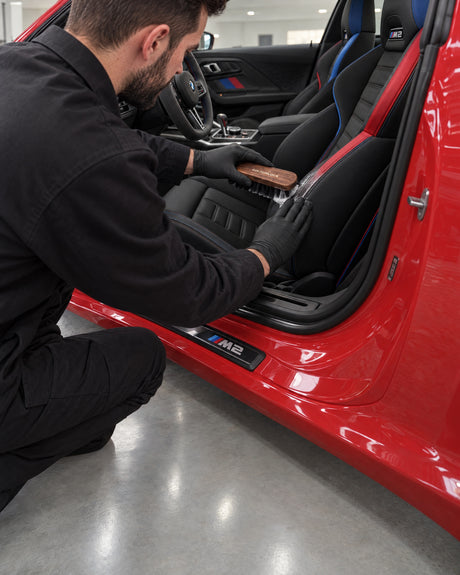
New: COLOURLOCK "Leather Cleaning Brush" lifts dirt out of the leather grain.


Koch-Chemie × COLOURLOCK
COLOURLOCK "Leather Cleaning Brush" with Wooden Body

SONAX
PROFILINE IntensivReinigungsBürste cleaning brush
Intensive Cleaning Brush — Robust Brush for Vehicle Interiors

Meguiars
Hair and Fibre Removal Brush Cleaning Brush
Electrostatic Pet Hair & Lint Cleaning Brush
Koch-Chemie
Drill Brush Set "Medium" Medium-stiff brush attachments for drill drivers (Yellow)
Koch-Chemie
Leather Brush Leather brush (Horsehair bristles)


Meguiars
Multi-Purpose Brush Medium Cleaning Brush
Versatile Detailing Cleaning Brush for Interior and Exterior

Koch-Chemie
Interior Brush Set Interior Detailing Brushes
What are interior brushes? Hand brushes and drill brush attachments that loosen dirt from carpet, fabric upholstery, leather, Alcantara and textured plastic. Bristle stiffness follows the material; a towel or vacuum picks up the loosened dirt. Smooth surfaces and clear instrument covers aren't part of the job.
Interior brushes are cleaning tools for surfaces in the car that have texture: carpet and floor mats, fabric upholstery, the grain of leather, the pile of Alcantara and textured plastic on sill plates and pedals. An interior brush is a tool for the agitation a cleaner can't deliver on its own: it pulls dirt out of fibres and pores a towel can't reach. Contours like air vents stay with the detailing brush, smooth surfaces with the microfibre towel.
Detailing1's tip from the shop: From what we see day-to-day, one order applies without exception: vacuum the surface before the brush gets wet. Sand in the bristles turns even a soft brush into an abrasive – on a fabric seat it roughens the fibres, on leather it leaves marks in the grain. Rinse the brush in clean water as you go, and never take the floor mat brush onto the seat.
An interior brush belongs on surfaces with texture – carpet, fabric upholstery, leather grain, Alcantara and textured plastic – where a towel only wipes over the top and the dirt stays down deep.
The line between brush and detailing brush is the shape of the surface. Air vent slats, switch edges and trim joints are contours; that's where a detailing brush with long, flexible bristles works. The types, sizes and colour systems are under Detailing brush. A brush, by contrast, puts pressure on a surface and loosens what has settled between fibres or in pores.
The line between brush and microfibre towel is smoothness. On hard plastic with no texture, a towel gets the dirt out completely; a brush only adds friction there.
An interior brush doesn't belong on displays, piano black trim or the instrument cluster cover. That's microfibre towel territory, with at most the softest detailing brush in the edges, light pressure and never dry. One driver describes in a comment under a car care video what happens otherwise: brushed dust out of the speedo cover, got scratches, and now only uses a damp microfibre towel there.
The rest of the tool family is under Brushes & detailing brushes. Which cleaner suits which material and in what order to work through the interior is covered in Interior cleaning; this page is about the tool that gets the cleaner into the surface.
Bristle stiffness follows the material: stiff for carpet and floor mats, medium for fabric upholstery, a dedicated leather brush for leather, very soft for Alcantara, tough for sill plates and pedals.
Carpet and floor mats hold sand between dense loops, and that calls for stiffness: a dedicated stiff brush for floor and boot, or the Drill Brush Set "Hard" on the drill.
For fabric seats and panels, use a second brush, such as the SONAX PROFILINE IntensivReinigungsBürste. According to the product description, its bristles are stiff enough for dried-on dirt and at the same time suited to the fibres of fabric seats. This brush stays on seats and panels and doesn't go near the floor mat. More models are in Upholstery brushes.
Leather has a grain – the fine pore structure of the surface where skin oils and dust settle. A leather brush works the cleaner into those pores instead of just spreading it around. The GYEON Q²M LeatherBrush is built for this; the wooden COLOURLOCK brush is medium-stiff and designed for dirt in the grain, on faux leather too. All models are in Leather brushes.
Alcantara is a suede-like fabric whose pile – the raised fibre ends – gives it that velvety feel. The manufacturer recommends a soft brush for dusting and raising the pile, no hard rubbing, no steam and no soaking. In practice: Alcantara gets the softest brush in the kit, never a carpet brush. How to stand the pile back up afterwards is covered in the article Cleaning Alcantara without ruining the pile.
Textured hard plastic on sill plates and pedals can handle stiffness; that's what Koch-Chemie names the red Interior Brush for. For gaps, trim strips, door seals and window channels, the Meguiars Multi-Purpose Brush Medium with its soft yet grippy bristles is a good fit.
A drill brush attachment takes over the heavy lifting on large textile areas like boot carpet and floor mats, while on leather, Alcantara and delicate fabrics your hand stays in control.
Koch-Chemie makes the Drill Brush Set in two stiffnesses with three attachments each. The three diameters split the work between open areas and corners. Medium in yellow is meant for textiles, upholstery, fabric seats and robust plastics; Hard in red for the load area, thick carpets and floor mats. Both sets fit common cordless drills – you don't need a dedicated machine.
Spray the cleaner onto the surface, not onto the spinning attachment. Otherwise the rotation flings liquid onto panels, glass and seats you never meant to treat. Set the attachment down flat before you pull the trigger, keep it moving and work in overlapping passes. Ease off the pressure at edges and seams – that's where the bristles bite first.
On car care forums, users report that rotary brushes quickly get too aggressive on seat fabric, and prefer to use them on carpet and floor mats. That matches the manufacturer's split: Hard only for the floor, Medium for upholstery. So on the seat, start with Medium, light pressure and low speed, and check the result on a hidden spot before tackling the whole seat.
No attachment goes on leather or Alcantara. The machine applies constant friction to one spot, and your hand can no longer feel when the grain or pile starts to give. The hand brush is slower, but you feel every stroke.
An interior brush that's too stiff roughens fabric seats and leaves white fuzz; one that's too soft leaves the sand in the carpet. The right stiffness depends on the material alone.
On one car care forum, users describe exactly that: white fuzz on the fabric seat after an upholstery clean, and the brush they used was really more suited to floor mats. Those comments are about other manufacturers' brushes, but the pattern holds. Take the carpet brush to the seat and the surface pays the price.
On leather, the same mistake plays out more quietly. Bristles that are too stiff can mark smooth leather, which is why leather gets its own leather brush. With delicate or re-dyed leather, test on a hidden spot before you start on the seat. Pressure and number of strokes are explained in the article Using a leather brush the right way.
Whether a fabric seat has picked up fuzz isn't visible from above, only in light coming in from the side. So check the first pass before you carry on – ideally once it's dry. If you see a pale sheen on the fibres, the bristle is too stiff or the pressure too high. Then switch to the medium brush and ease off, rather than scrubbing the whole area to the end.
The other way round, a brush that's too soft won't shift carpet dirt. Sand sits at the base of the fibres, and a leather brush just glides over the top. So no single brush covers the whole interior. The minimum is two separate tools: a stiff one for floor and boot and a dedicated one for the seats – a leather brush if you have leather seats. The second tool protects the seat from the sand off the floor.
One advice request shows where the line sits in everyday use: if you want to care for smooth leather seats and a textured dashboard with a leather cleaner, you need a leather brush, not a fabric brush. The fabric brush stays on fabric and carpet.
The brush provides the agitation, the cleaner the chemistry, and only a towel or vacuum picks up the loosened dirt; without that last step, it stays in the surface.
The basic routine: vacuum thoroughly, put cleaner or foam on the surface or straight onto the brush, work it in with short strokes, pick up the loosened dirt with a microfibre towel or the vacuum, let it dry. On leather and Alcantara, the cleaner goes on the brush, never directly onto the surface; Alcantara doesn't get scrubbed – the soft brush works there without pressure. Pressure depends on the material, not on the dirt. Where dirt is stubborn, dwell time helps more than force.
On door cards with window switches, on speaker grilles and around the centre console, one small thing changes: the cleaner goes on the brush, not on the surface. Otherwise liquid runs into openings and switches no towel can reach. The brush can be damp, not dripping, and you work away from the opening rather than towards it.
With Alcantara and suede, there's one last step once it's dry: brush the pile upright in one direction with the soft brush. As long as the fibres lie flat, the surface looks patchy even though it's clean. Only this step makes the difference between cleaned and cared-for visible.
Pet hair is a case of its own. It hooks into carpet and fabric covers; a brush with rubber or special bristles rolls it into clumps, but you still have to vacuum. On forums, the options range from a rubber glove to a dedicated brush. Only once the hair is out does the Upholstery cleaner go on – otherwise it sticks to the damp fibre.
On your first go, a driver's seat takes longer than you'd think, because you have to dial in pressure and amount of cleaner first. That's part of it – the second seat goes faster. According to Google Trends data, interest in interior cleaning peaks in February. The link with winter seems obvious, but only the timing is proven.
A family car with fabric seats needs a stiff tool for floor and boot, the SONAX brush for the seats and the red Interior Brush for sill plates; leather seats need a leather brush on top.
If you have a lot of carpet – say a big boot or pet hair in the load area – the Hard set on the drill saves you effort. Loosen and vacuum up the pet hair first, then the attachment works the cleaner into the carpet. If you have leather seats, use the GYEON brush or the COLOURLOCK wooden brush with a suitable Leather cleaner, and keep fabric brushes away from them.
For a plain commuter car with fabric seats and rubber mats, stick to the minimum: the SONAX hand brush for seats and panels, the red interior brush for sill plates and pedals, and a dedicated stiff brush for the carpet under the mats. You don't need the drill attachment or a leather brush there.
The drill attachment only pays off once there's a lot of carpet involved, and a leather brush only if there's leather in the car. More tools won't make the interior any cleaner if they end up on the wrong surfaces.
What no brush can do: stains from coffee, grease or dye are dissolved by chemistry, not bristles. Scrub a stain with pressure and you're more likely to spread it than lift it, roughening the fabric in the process. The right cleaner goes on the surface first; the brush just works it in and gives it time.
If you want to stay within the Koch-Chemie system, you'll find the brand's interior brushes and detailing brushes grouped under Interior brushes by Koch-Chemie. With the Drill Brush Set, the colour also helps when sorting the shelf: yellow means Medium, red means Hard.
In the end, one rule matters more than any stiffness grade: a brush stays on its surface. The brush that pulled sand out of the floor mat today will carry it onto the leather seat tomorrow if it switches surfaces. Mark which brush is for the floor, and always use a separate one for seats and leather. That way you avoid the scratches nobody can explain afterwards.
Too much choice in Interior brushes? Get help picking:
Für Teppich und Fußmatten eine steife Bürste oder das Koch-Chemie Drill Brush Set "Hard" auf dem Akkuschrauber, für Stoffsitze eine mittlere Borste mit wenig Druck, für Leder eine eigene Lederbürste wie die GYEON Q²M LeatherBrush. Alcantara bekommt die weichste Bürste. Eine Bürste für alles gibt es nicht, weil Sand aus dem Teppich sonst auf den Sitz wandert.
Stoffsitze ja, mit dem mittelharten Aufsatz: Koch-Chemie ordnet das Koch-Chemie Drill Brush Set "Medium" Textilien, Polstern und Stoffsitzen zu, das Hard-Set nur Laderaum, dicke Teppiche und Fußmatten. Beginne mit wenig Druck und niedriger Drehzahl an einer verdeckten Stelle. Leder- und Alcantarasitze reinigst du von Hand.
Genarbter Hartkunststoff an Einstiegsleisten und Pedalen verträgt eine harte Borste, Koch-Chemie nennt dafür den Koch-Chemie Interior Brush "Rot", auch für andere grobe Arbeiten. Glatter Kunststoff ohne Narbung braucht keine Bürste, dort reicht ein Mikrofasertuch. Für Lüftungsgitter und Kanten sind die Detailing-Pinsel gedacht.
Ganz ohne Abrieb arbeitet keine Bürste, eine saubere Lederbürste mit Lederreiniger hält das Risiko aber klein. Spuren entstehen durch zu harte Borsten, Sand in den Borsten, zu viele Züge oder einen Bürstenaufsatz für den Akkuschrauber. Nimm eine eigene Lederbürste nur für Leder und teste nachgefärbtes Leder zuerst verdeckt. Perforiertes Leder bürstest du nicht.
Sie löst sie, herausholen musst du sie trotzdem mit dem Sauger. Tierhaare verhaken sich in Teppich und Stoff, eine Bürste mit Gummi- oder Spezialborsten oder ein Gummihandschuh zieht sie zu Knäueln zusammen. Erst danach kommt ein Polsterreiniger, sonst kleben die Haare an der feuchten Faser fest.
Auf glatten Flächen ja: Hartplastik ohne Narbung, Displays, Klavierlack und die Abdeckung des Kombiinstruments gehören dem Tuch. Auf Teppich, Stoffpolster, Ledernarbung und Alcantara wischt das Tuch nur über die Oberfläche, der Schmutz in der Tiefe bleibt. Dort löst die Bürste, und das Tuch nimmt danach auf, was sie gelockert hat.
Daniel von Detailing1 |

Daniel von Detailing1 |

Jasper von Detailing1 |

Daniel von Detailing1 |

Daniel von Detailing1 |

Daniel von Detailing1 |

Jasper von Detailing1 |

Jasper von Detailing1 |

Daniel von Detailing1 |

Daniel von Detailing1 |

Daniel von Detailing1 |

Daniel von Detailing1 |


