


5 leather brush mistakes that roughen car leather
Daniel von Detailing1 |


Koch-Chemie
Nano Glass Sealant "Ng" Windscreen Sealant Set
Long-lasting nano-technology glass sealant for clear vision
D-CON
Ceramic-Glass-Clean & Protect glass cleaner with sealant
Clear view in any weather


CarPro
"FlyBy30" Windshield Rain Repellent Glass Sealant
Glass sealant for clear vision
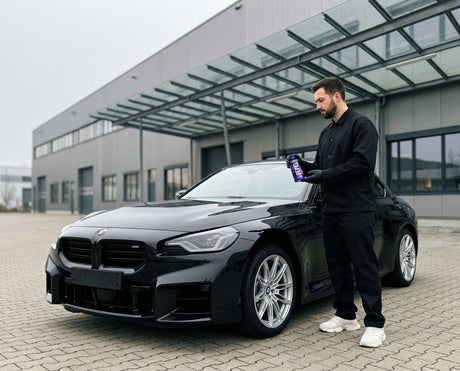
GYEON Q² View EVO cures properly during the dry days.

Prepare grease free, apply thinly, let it flash off.
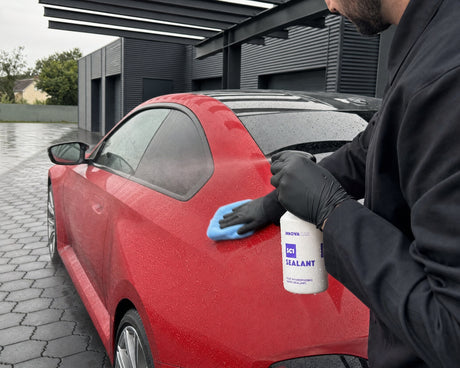
Message us on WhatsApp and we will find the right protection for your car.
What does a glass sealant do? It lowers how well water sticks to glass, so rain pulls into round droplets and, from around sixty to eighty km/h, rolls up and away without wipers. At Detailing1 you'll find ceramic coatings, fluoropolymer sprays and ready-to-use applicator bottles.
Window sealing is a thin, chemically bonded protective layer on car glass that lowers the glass's surface energy. Water can no longer spread out flat on it and pulls together into beads that the airflow carries off sideways and upwards. Depending on the chemistry, the layer lasts from a few months to over a year. As a bonus, bug remains, tree sap and limescale stick less, because they barely find direct contact with the glass anymore.
Detailing1's tip from the shop: We regularly get questions about sealants that only bead in streaks after four weeks, always in the same pattern across the wiper area. The cause is rarely the product. Almost always the glass was cleaned but the old film was never stripped, and the wiper blade then sands off the fresh layer exactly where it rests. So only apply the sealant after a proper glass decontamination, and swap the wiper blades in the same session. Together that costs you half an hour and, in our experience, doubles the time water keeps rolling off cleanly.
On untreated glass, water spreads out flat. On sealed glass, it pulls together. That one change takes care of the rest.
Chemically speaking, car glass is a surface full of silanol groups, oxygen-hydrogen ends that actively attract water molecules. The droplet finds grip everywhere and spreads into a film. A film has a lot of contact area and little for the wind to catch, so it stays put until the wiper pushes it away.
A sealant occupies exactly those ends. Silane or fluorine compounds dock where the water used to dock and point their water-repellent molecular tails outwards. What that means for you: the glass no longer offers the water anything to hold on to, the droplet stays a bead and rolls off at the slightest tilt.
The speed at which this works without wipers depends on the angle of the windscreen and the condition of the layer. With a fresh sealant on a steeply raked windscreen, the airflow pressure from around sixty km/h is enough to pull the droplets up and away. More upright windscreens on vans and older cars need closer to eighty.
The side windows benefit differently from the front. There's no pressure build-up there, the water simply runs down faster and doesn't hang as a haze. When manoeuvring in the rain, you can see the door mirror again without lowering the window, and that's the point where most customers consciously notice the effect for the first time.
We stay honest about what to expect in town. Below thirty km/h, no droplet moves on its own, and waiting at the lights the water sits on the glass just like before. The sealant doesn't do the wiper's job for you, it shifts its range of use downwards and keeps the view cleaner in between.
Contact angle is the figure manufacturers advertise with in this category, and it really is the most meaningful number in the whole product group.
It means the angle a water droplet forms at its edge with the surface. Untreated car glass sits at about twenty to thirty degrees, the droplet looks like a flat pancake and sticks with its whole underside. A fresh sealant takes the surface above a hundred degrees, so the water sits on the glass as a bead and only touches it at a small point.
How you notice: it takes very little force to get something moving. Less contact area means less adhesion, and less adhesion means even a light breeze or a small tilt gets the droplet rolling. That's exactly why the same amount of rain sits on one windscreen and runs away on another.
In the scene, two terms are used side by side. Beading describes the round, standing droplets on a fresh coating, sheeting the water sliding off as a continuous sheet. Both are wanted, just at different times: beading shows an intact layer, sheeting gives you a clear view faster when driving.
The value ages, and measurably so. A coating that starts at a hundred and ten degrees often only reaches eighty to ninety after six months of everyday use with wipers, cleaners and screenwash antifreeze. The droplets then sit flatter, need more airflow and stay put more often at country road speed. That's the moment to top up, not when nothing beads at all anymore.
That's why we check with a simple test instead of the calendar. Pour half a bottle of water over the glass while the car is parked. If it runs back as a closed curtain and leaves the surface wet, the layer is gone. If it breaks up into droplets that roll straight off, you've still got some left in the tank.
All products in this category do the same thing, and they do it with different chemistry, different durability and very different demands on how careful you are.
The toughest group is ceramic coatings based on silicon dioxide. They form a network of silicon and oxygen that bonds firmly with the glass instead of just sitting on top. In practice: long durability, high resistance to cleaners and antifreeze, but an application that doesn't forgive mistakes. The SONAX PROFILINE CeramicCoating „CC" Glass ceramic glass coating (12 months) is our best seller in this group.
The second group works with fluoropolymers, the same class of substance that gives frying pans their non-stick coating. It's a bit softer, more forgiving during application and delivers very high contact angles from the first minute. The GYEON Q² View EVO Rain Repellent Glass Coating belongs here, as does the Meguiars PERFECT CLARITY Glass Sealant as an easy entry point.
In between are the kits that supply prep and sealant together. The Koch-Chemie Nano Glass Sealant „Ng" Windscreen Sealant Set puts the cleaning pre-treatment and the coating in the same box. For anyone sealing for the first time, it's the safest route, because the most important step can no longer be forgotten.
Products for plastic windows are a category of their own. The Soft99 Glaco Blave Plastic Sealant is made for polycarbonate, meaning headlight covers, motorcycle screens and fairing parts. It has no place on a laminated glass windscreen, but it solves a problem the glass products mustn't touch.
When it comes to pack size, there's a simple rule in this category: small is right. Thirty to seventy millilitres are enough for several complete cars, and opened bottles of silane chemistry react with humidity and thicken over time. A bulk pack gives you no advantage here, just product ageing on the shelf.
No other factor decides the result so clearly. On glass that hasn't been decontaminated, the best sealant lasts no longer than the cheapest.
The problem is invisible. After a few years, every windscreen carries a mix of old rain repellents, silicone from care products, plasticisers washed out of the wiper rubbers and dried-in limescale. A glass cleaner takes off the top layer and leaves the rest, because it isn't made for that.
But the new layer needs free anchor points on the glass. If it finds old film instead, it bonds to that film rather than the glass, and the bond is only as strong as its weakest layer. After a few weeks the base comes away in patches along with the sealant, and that's exactly the pattern we see in almost every complaint in this category.
The clean route is a mechanical pass. A glass polish with cerium oxide or a mildly abrasive pre-treatment strips the old film, followed by a wipe with isopropyl alcohol to pick up grease and silicone residue. You check with water: if the glass stays evenly wet all over and doesn't bead anywhere, it's truly clean.
The squeak when you run a clean finger over it is the second reliable sign. If the surface feels dull or slightly greasy, something's still on it. For a windscreen this step takes between twenty and forty minutes, and much less the second time, because only your own previous layer has to come off.
For ongoing care after that, a normal glass cleaner without added silicone is all you need. If you're after the whole process from stripping to building protection, you'll find the right pre-steps under paint preparation, because the order on glass is the same as on paint.
Most product descriptions leave this point out, and it answers the most common question in this category.
A wiper blade is a rubber lip dragged over the glass under spring pressure. Your fresh coating sits exactly in that strip, and the rubber wears it down microscopically with every pass. That's why a sealant ages much faster in the wiper area than at the edge of the windscreen, and that's why you get the typical pattern of a beading edge and a dull centre.
Then there's a second effect that's often mistaken for a faulty product. On a strongly water-repellent windscreen, the wiper blade lacks the water film it normally glides on. It touches down briefly, skips on and chatters or squeaks as it goes. That's not a fault of the sealant, it's the result of the glass having become too dry for the blade.
Three things sort this out day to day. Old, hardened wiper blades come off before sealing, because cured rubber skips the most. The intermittent setting goes one step slower, because fewer passes mean less wear. And dry wiping is out altogether, that's what the washer jet is for.
If you still want peace in the wiper area, build top-ups into your routine. A booster from the same product family, applied to the wiper area every two to three months, keeps the contact angle up there without having to prep the whole windscreen again. That's the pragmatic answer to a conflict you can't argue away.
And let's clear up one expectation right away. A glass sealant doesn't replace the wiper blades, it just stretches the distances where you don't need them. Driving at thirty in heavy rain, you'll keep wiping. Doing lots of motorway and night driving, you'll notice the difference on every trip.
The decision comes down to three questions: how much you drive, how often you fancy doing the application and how confident you feel applying it.
If you do lots of motorway miles, often in the dark, and want peace for a year, the ceramic coating is the right choice. The SONAX PROFILINE CeramicCoating „CC" Glass ceramic glass coating (12 months) lasts longest and shrugs off antifreeze concentrates in winter too. But you really do need to plan in the prep effort.
If you want to see the effect quickly and get the application done without stress, go for fluoropolymer. The GYEON Q² View EVO Rain Repellent Glass Coating is the most forgiving of uneven application and delivers very round droplets from the first rain. For a second car or a lease vehicle with a manageable term left, that's the more pragmatic sum.
If it's your first time sealing, take the kit. The Koch-Chemie Nano Glass Sealant „Ng" Windscreen Sealant Set forces you into the right order, and in this category the order is half the battle. The Meguiars PERFECT CLARITY Glass Sealant is the second good entry-level answer if the glass has just been polished anyway.
If it's yellowed headlights or a motorcycle screen you're dealing with, the glass products are the wrong place. The Soft99 Glaco Blave Plastic Sealant is made for these plastics and holds where silane coatings for glass find nothing to bond to.
The right cleaner for ongoing care is under glass cleaner, and everything around it, from glass care to accessories, under Window and glass cleaning. The first application is the work, everything after that is just keeping on top of it, and that's exactly why it pays to do it right once.
Too much choice in Window sealing? Get help picking:
Daniel von Detailing1 |

Jasper von Detailing1 |

Daniel von Detailing1 |

Daniel von Detailing1 |

Daniel von Detailing1 |

Jasper von Detailing1 |

Jasper von Detailing1 |

Daniel von Detailing1 |

Daniel von Detailing1 |

Daniel von Detailing1 |

Daniel von Detailing1 |

Daniel von Detailing1 |


