


What a car leather sealant protects and what it doesn't
Daniel von Detailing1 |


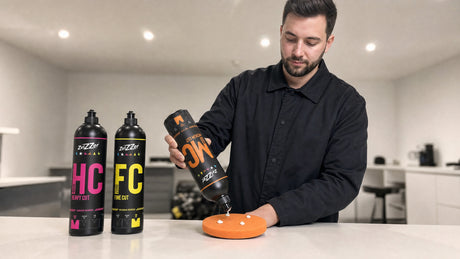
Pads, Polituren und Fahrzeugpflege der Marke.


ZviZZer
Graphene Spray Coat Spray Sealant
Graphen-Sprühversiegelung für Lack mit Abperleffekt und Tiefenglanz
ZviZZer
Saures Autoshampoo pH 3,4 bis 3,8 für versiegelte Lacke und Kalk
ZviZZer
Clean Top Paint Cleaner / Degreaser
Lackreiniger und Entfetter zur Polier-Endreinigung vor dem Schutz
ZviZZer
pH-schonendes Autoshampoo für die Handwäsche ohne Schutzabbau
ZviZZer
Protection Gloss Cream Sealant
Cremige Lackversiegelung auf Wachsbasis für Glanz und 5-7 Monate
ZviZZer
Sprühwachs aus Wachs und Versiegelung für schnellen Glanz und Schutz
ZviZZer
Sprühversiegelung für den nassen Lack mit starkem Abperleffekt
ZviZZer
Wasserbasierter Quick Detailer für Glanz zwischen den Wäschen
ZviZZer
Wax "Graphene" Graphene Wax / Wax Sealant
Graphenverstärktes Hand-Hartwachs mit bis zu 12 Monaten Standzeit
ZviZZer
Synthetisches Hartwachs mit langer Standzeit und Abperleffekt
Car care from ZviZZer is the protection and wash range that takes over once the polishing is done: coatings, spray sealant, wax and shampoo. You build up protection and keep it going — from two months of spray-on freshness to four years of ceramic.
Car care from ZviZZer isn't a single product — it's the second half of a workflow. The first half is polishing: that's what takes swirls and holograms out of the paint. Whatever comes next locks that condition in and protects it. That's exactly what this range does — ceramic coating, spray sealant, hand wax and car shampoo, graded from a few weeks to more than four years of durability.
Detailing1's tip from the shop: The most common mistake is the order. We often see a coating go onto freshly washed but unpolished paint — and the swirls underneath are then locked in for two or three years. A sealant doesn't correct anything. Polish first, then degrease with isopropanol, then protect. Stick to those three steps and you'll get the full durability out of every product on this page.
Every product on this page preserves a condition. It doesn't improve it. That's the most important sentence in the whole category.
A sealant lays down a thin layer over the clear coat and seals it. If there are scratches, holograms or dull patches underneath, they stay visible — the layer can even make them stand out more, because it reflects. That's why correction with a polish always comes first, and only then the protection.
After polishing comes a step a lot of people skip: degreasing with isopropanol, known in detailing as paint prep or an IPA wipe-down. It removes polishing oil residue that would otherwise act as a barrier layer. What that means for you: without a grease-free surface, the coating won't bond fully and the promised durability will be much shorter. One minute of wiping decides months of protection.
How the product then bonds to the surface depends on what it is. A ceramic coating forms a silicon-oxygen network — a wafer-thin, glass-like lattice that chemically bonds to the clear coat. A wax sits physically on top; a spray topper latches on with polymers. In plain terms: coating means a firm bond and years, wax means a film sitting on top and months. That one distinction explains almost every durability difference on this page.
Three classes of protection, three levels of effort. The choice depends on how much time you put in and how long you want to be left in peace.
The ceramic coating is the top tier: a hybrid silicon-polymer hard coating that forms a tough non-stick surface once cured. Durability is 30 to 36 months for the Paint Ceramic Coat and 42 to 48 months for the graphene-reinforced Graphene Ceramic Coat. The price is work: several hours of application, crosswise, flash off, level off, then days of curing without water. Which of the two suits you is explained in detail under Ceramic Coating from ZviZZer.
Hand wax sits in the middle. The carnauba-based Wax Natural lasts 4 to 8 months and gives that warm, deep natural gloss dark paint loves. The polymer-based Wax Synthetic lasts 6 to 10 months with more even beading, and the Wax Graphene 8 to 12 months as the toughest tier. You apply all three by hand, no machine — thin with the applicator, let it flash off, buff it off.
Spray sealant is the fast class. Spray on, spread thin, buff off — done in minutes, no prep needed. The trade-off is durability: Wet Coat lasts 2 to 3 months, Graphene Spray Coat 3 to 5 months. It's less a coating substitute than a booster that feeds the existing layer after every wash.
What all three classes share is hydrophobicity — the surface repels water instead of holding it. Water breaks up into beads and rolls off instead of drying as a film. What that means for you: fewer water spots after rain, easier drying, fewer micro-scratches when you towel off. With the graphene-reinforced coating and spray, there's also an antistatic effect that repels fine dust and keeps the car clean for longer.
A coating lasts for years, but its hydrophobic effect fades a little with every wash and every day of UV. That gap in between is exactly where the spray products come in.
Quick Shine, Wet Coat, Hybrid Wax Spray and Graphene Spray Coat are designed as toppers. You spray them onto the still slightly damp or dry paint after washing and buff them off with microfibre. They lay fresh polymers or graphene nanosheets onto the base layer and bring the beading back. In practice: your two-year-old coating beads like day one again after a topper.
The Graphene Spray Coat brings an extra benefit that pure waxes don't have. Graphene is carbon and conducts electricity — which makes it antistatic. Put simply: the paint builds up less charge, attracts less fine dust and stays visibly clean for longer between washes. Which spray type makes sense on which surface is covered under Spray Sealant from ZviZZer.
Within the spray family there are grades. Quick Shine is the pure gloss detailer for in between, 1 to 2 months. The Hybrid Wax Spray combines wax with polymer resins and lasts around 3 months, because it builds up more protective film. The Protection Gloss Cream is a bit of an outlier: it goes on by hand as a cream rather than a spray, and at 5 to 7 months it lasts the longest in the quick hand-applied protection tier. Three speeds, same idea.
There's a limit, too: no spray corrects anything. On unwashed paint, your towel drags grit across the clear coat and creates new scratches. And none of them replaces a coating if you want real multi-year protection — the sprays are maintenance, not a foundation.
Washing is the least glamorous but most frequent part of the routine. ZviZZer splits it into two shampoos with clearly different jobs.
The Allround Shampoo is the maintenance wash. It has a pH of 9.0 — slightly alkaline, explicitly not pH-neutral. Day to day, you won't notice anything negative: it foams up well, builds a slick film that lets the wash mitt glide over the paint, and doesn't touch an existing wax or ceramic layer. Dosage is 15 to 30 ml per 5 litres of water, so one litre gets you about 40 buckets.
The Sour Shampoo is the acidic counterpart at pH 3.4 to 3.8. It's not a weekly shampoo but a maintenance step every four to eight washes. Its acidity dissolves mineral deposits — limescale and dried-on water spots — and neutralises alkaline cleaner residue. On a sealed car it brings fading beading back to life without attacking the coating. Which shampoo to use when is laid out under Car Shampoo by ZviZZer.
Why acidic at all? Water spots are limescale — dissolved minerals left behind as a white ring when the water dries. An acid dissolves these carbonates and rinses them away, where a normal shampoo just glides over them. You'll notice it when that dull haze after a summer shower disappears without you having to reach for polish. That's exactly why the Sour belongs in your maintenance routine, not in every wash.
What we see day-to-day: if you combine the two, wash regularly with the Allround and only reach for the Sour when the water leaves spots after drying. Both work as a snow foam through the foam cannon or in a classic two-bucket wash. One limit we know well from customer questions: both shampoos are for washing — they're not bug, tar or iron fallout removers. Stubborn organic contamination needs a pre-treatment, or you'll end up scrubbing and risking scratches.
ZviZZer grades its protection products on a clear ladder from a few weeks to more than four years, and those figures hold up — they're not dressed up.
From bottom to top: Quick Shine 1 to 2 months, Wet Coat 2 to 3 months, Hybrid Wax Spray 3 months, Graphene Spray Coat 3 to 5 months, Wax Natural 4 to 8 months, Protection Gloss Cream 5 to 7 months, Wax Synthetic 6 to 10 months, Wax Graphene 8 to 12 months, Paint Ceramic Coat 30 to 36 months, Graphene Ceramic Coat 42 to 48 months. Every step up costs more effort to apply.
The honest context matters: all these figures apply to well-maintained cars. A car that lives outside, racks up motorway miles and rarely gets washed will land at the bottom of the range. A car that's kept dry and under cover and gets regular top-ups will hit the top. Take the Wax Natural from Wax from ZviZZer: with Quick Shine top-ups it lasts noticeably longer than without.
The biggest lever on durability isn't the most expensive product — it's the topper. A wax or coating that gets a fine mist of Quick Shine or Graphene Spray Coat after every wash lasts noticeably longer than the same product left to fend for itself. In practice: two minutes per wash extends the protection by weeks. Maintenance beats product class.
And none of these layers is stone-chip protection. Harder than factory paint, yes — with the Paint Ceramic Coat, the clear coat becomes about 60 to 65 percent more scratch-resistant. But against a stone chip on the motorway, only paint protection film helps, not a coating. We'd rather say that up front than have your expectations let down afterwards.
The decision boils down to one question: how much time will you give the application, and how long do you want to be left in peace afterwards?
If you want to do the job properly once and then have two to four years of peace, the coating is your route — Paint Ceramic Coat for solid, balanced ceramic protection, Graphene Ceramic Coat for maximum hardness, hydrophobicity and antistatic effect. Both need a clean, polished, degreased surface and a bit of experience with levelling off quickly so no high spots are left behind.
If you like the classic wax look and the ritual of hand application, go for one of the three waxes — Natural for that warm carnauba gloss, Synthetic for the practical middle ground, Graphene for maximum durability. If you want it even simpler, grab the Protection Gloss Cream, the creamy hand-applied sealant with 5 to 7 months.
A typical build-up from real-world use looks like this: polish the paint, degrease with isopropanol, lay down the Graphene Ceramic Coat as the foundation, let it fully cure. After that, maintenance almost runs itself for months — Allround Shampoo for washing, a spray topper every few weeks, and the Sour Shampoo as soon as limescale rings show up after rain. That's how you push the coating's durability to the top of its range.
And for ongoing care in between: wash regularly with the Allround Shampoo, descale with the Sour when needed, and top up with a spray topper after washing. That way you build protection once and then keep it going with minimal effort — that's the whole idea behind the ZviZZer care range. One brand, one system, from the first coating to the wash two seasons down the line.
Too much choice in Car Care from ZviZZer? Get help picking:
Daniel von Detailing1 |

Daniel von Detailing1 |

Jasper von Detailing1 |

Daniel von Detailing1 |

Daniel von Detailing1 |

Daniel von Detailing1 |

Jasper von Detailing1 |

Jasper von Detailing1 |

Daniel von Detailing1 |

Daniel von Detailing1 |

Daniel von Detailing1 |

Daniel von Detailing1 |


