

5 leather brush mistakes that roughen car leather
Daniel von Detailing1 |


Koch-Chemie
Cleans thoroughly and gently, preserves the shine of the paint surface
Koch-Chemie
Gentle Snow Foam "Gsf" Cleaning Foam
pH-neutral pre-wash foam for weekly paint care
Koch-Chemie
Ceramic Effect Shampoo "Ces" Maintenance Shampoo with Long-Term Sealant Effect
Care shampoo with SiO₂ sealant for coating-compatible hand wash


Koch-Chemie
Pump sprayer with 1:1 to 1:10 scale for interior concentrates

Koch-Chemie
Applicator Sponge for Plastic, Rubber & Leather Care
Koch-Chemie
Wash & Finish "Wf" Waterless-Wash Detailer
Must-have for a waterless wash with brilliant results

Koch-Chemie


Koch-Chemie
Exterior Wash Mitt 640GSM Microfibre Wash Mitt


Koch-Chemie
Rapid Rinseless Wash "Rrw" — Rinseless Car Wash
Fast, paint-friendly washing without rinsing
iK Sprayers
"iK Foam" Pro 2+ (Plus) Pump Foam Sprayer with Compressor Valve (incl. Colour Coding)
Professional pump foam sprayer for versatile cleaning tasks
Koch-Chemie
Active Foam "Af" Intensive Foam
Effective Intensive Foam for Professional Vehicle Care
Koch-Chemie
Super Foam Fruit Bowl "Sff" cleaning foam
Fresh scent & intensive cleaning
iK Sprayers
"iK Foam" Pro 2 Pump Foam Sprayer (incl. colour coding)
Professional foam sprayer for versatile car care


THE COLLECTION
"Aqua" Twisted Loop Drying Towel (1500 GSM)
Premium Twisted Loop Drying Towel with Extreme Absorbency


YETI
LoadOut® Bucket / 19 Litre Bucket
Extremely robust 19 litre bucket, ideal for car care.


SONAX
PROFILINE ActiFoam "Energy" Cleaning Foam (Snow Foam)
pH-neutral snow foam cleaner for contactless pre-wash

Koch-Chemie
Magic Eraser Specialist Sponge


Koch-Chemie
Pro Drying Towel 950GSM Microfibre Drying Towel
Koch-Chemie
Ultra Foam "Uf" Snow Foam / High-foaming foam for the self-service wash
Snow Foam Concentrate pH 8.5 for pre-wash with sealant tolerance


Koch-Chemie
Gentle Snow Foam X-Mas "Gfx" cleaning foam
pH-neutral cleaning foam with a festive scent
Koch-Chemie
TUGA Chemie
Alkaline Insect Remover Gel pH 9 with Low VOC Content
Koch-Chemie × THE FINISHER
THE FINISHER "InsectOff" Bug Remover
For gentle and quick removal of insect residue
Car wash pulls together the three-stage wash at Detailing1: pre-cleaners lift heavy dirt touch-free, snow foam softens the rest and rinses it away, and car shampoo gives you the slick film for the hand wash. The fewer particles that reach the wash mitt, the fewer swirls end up in the clearcoat. Brands are Koch-Chemie, SONAX, GYEON, Meguiar's, CarPro and INNOVACAR.
Koch-Chemie
Cleans thoroughly and gently, preserves the shine of the paint surface
Koch-Chemie
Ceramic Effect Shampoo "Ces" Maintenance Shampoo with Long-Term Sealant Effect
Care shampoo with SiO₂ sealant for coating-compatible hand wash
Koch-Chemie
Applicator Sponge for Plastic, Rubber & Leather Care
Koch-Chemie
Wash & Finish "Wf" Waterless-Wash Detailer
Must-have for a waterless wash with brilliant results
Koch-Chemie
Koch-Chemie
Exterior Wash Mitt 640GSM Microfibre Wash Mitt
Koch-Chemie
Rapid Rinseless Wash "Rrw" — Rinseless Car Wash
Fast, paint-friendly washing without rinsing
YETI
LoadOut® Bucket / 19 Litre Bucket
Extremely robust 19 litre bucket, ideal for car care.
Koch-Chemie
Magic Eraser Specialist Sponge
Koch-Chemie
Koch-Chemie
Koch-Chemie Reinigungsknete "Rkb" Mild "Blau" Clay Bar
Gentle cleaning for paint and glass with detailing clay

Koch-Chemie
Detailing Bucket Wash Bucket 20L
20-Liter Profi-Wascheimer für das kratzerfreie Zwei-Eimer-System

Vorwäsche löst haftende Verschmutzungen an, bevor ein Waschmedium den Lack berührt. Vorreiniger und Snow Foam unterscheiden sich in Rezeptur und Auftrag; das Schaumvolumen allein beschreibt keine Reinigungskraft. Schmutzart, Oberflächenfreigabe und bestehende Versiegelung bestimmen die Auswahl für den anschließenden Waschgang.
Koch-Chemie
Gentle Snow Foam "Gsf" Cleaning Foam
pH-neutral pre-wash foam for weekly paint care
Koch-Chemie
Pump sprayer with 1:1 to 1:10 scale for interior concentrates
iK Sprayers
"iK Foam" Pro 2+ (Plus) Pump Foam Sprayer with Compressor Valve (incl. Colour Coding)
Professional pump foam sprayer for versatile cleaning tasks
Koch-Chemie
Active Foam "Af" Intensive Foam
Effective Intensive Foam for Professional Vehicle Care
Koch-Chemie
Super Foam Fruit Bowl "Sff" cleaning foam
Fresh scent & intensive cleaning
iK Sprayers
"iK Foam" Pro 2 Pump Foam Sprayer (incl. colour coding)
Professional foam sprayer for versatile car care
SONAX
PROFILINE ActiFoam "Energy" Cleaning Foam (Snow Foam)
pH-neutral snow foam cleaner for contactless pre-wash
Koch-Chemie
Ultra Foam "Uf" Snow Foam / High-foaming foam for the self-service wash
Snow Foam Concentrate pH 8.5 for pre-wash with sealant tolerance
Koch-Chemie
Gentle Snow Foam X-Mas "Gfx" cleaning foam
pH-neutral cleaning foam with a festive scent
TUGA Chemie
Alkaline Insect Remover Gel pH 9 with Low VOC Content
Koch-Chemie × THE FINISHER
THE FINISHER "InsectOff" Bug Remover
For gentle and quick removal of insect residue
Trocknen entfernt das verbleibende Wasser nach der Fahrzeugwäsche. Trockentücher nehmen Wasser von Flächen auf, ein Gebläse erreicht Spalten und Trocknungshilfen ergänzen den Ablauf je nach Rezeptur. Oberfläche, Kontur und bestehender Lackschutz bestimmen die Auswahl; gereinigte Arbeitsmedien gehören zu einem kontrollierten Finish.
THE COLLECTION
"Aqua" Twisted Loop Drying Towel (1500 GSM)
Premium Twisted Loop Drying Towel with Extreme Absorbency
Koch-Chemie
Pro Drying Towel 950GSM Microfibre Drying Towel

Koch-Chemie
Drying Towel 430GSM Waffle Microfibre Cloth


The Rag Company
The Liquid8r 1100GSM Twisted Loop Microfibre Drying Towel
1100GM drying experience with premium twisted loop microfiber
D-CON
Thunder Grizzly 1800GSM Microfibre Drying Towel
Premium Microfiber Drying Towel with Maximum Absorbency
The Rag Company
"The 1500" GSM Microfibre Drying Towel
Impressive 1500 GSM density and premium twist loop microfiber


The Rag Company
The Gauntlet 900GSM Microfibre Drying Towel
Revolutionary microfiber drying cloth for professional detailing


GYEON
Q²M SilkDryer EVO "Twisted Loop" Drying Towel (530 GSM)

Meguiars
1200 GSM Duo-Twist Microfiber Drying Towel 50×90 cm


Soft99
Max Wash 4Pockets Drying Towel
Quick-drying, efficient vehicle cloth


THE COLLECTION
"Striped 2.0" Hybrid Fibre Blend Microfibre Drying Towel (950 GSM)
Hybrid Drying Towel with Extreme Absorbency


What goes into washing a car? Three steps in a fixed order: the pre-wash loosens dirt before anything touches the paint, the contact wash with shampoo and wash mitt takes it off, and drying removes the leftover water before limescale is left behind. Which products you need depends on where you wash.
Washing your car covers everything between dirty paint and dry paint, and it follows a fixed order: loosen the dirt first, then take it off, then get rid of the water. The order decides the state of your paint, because every grain of sand still sitting on the paint at first contact gets dragged across the panel under the mitt. You'll find the three steps under Pre-wash, Car wash and Drying.
Detailing1's tip from the shop: At a self-service wash bay, the foam brush only goes on your paint once you've rinsed it out thoroughly, because previous users leave dirt in it. ZDFheute gives the same advice. The bay's wheel brush never touches your paint. Your own wash mitt or a cover for the brush is the safer bet.
Whether washing your car leaves scratches is decided first by how much dirt is still on the paint when the wash mitt touches it for the first time. The Car shampoo then provides the slick film. If there's still sand or brake dust there, the mitt drags it across the clear coat under pressure. Why those grains are harder than the paint is explained in detail on the car wash page.
A 2022 test by KÜS and AUTO BILD didn't test lubricity: all nine car shampoos tested cleaned equally well, even though the dosing recommendations ranged from 3 to 300 millilitres per 10-litre bucket. More foam didn't mean more cleaning in the test. What that means for you: with shampoo, what counts is the slick film and compatibility with your paint protection, not the foam head in the bucket.
The contact wash is the step where mitt or towel touch the paint. Everything before it has one purpose only: to cut down the number of particles that end up under the mitt. That's why the ADAC considers a pre-wash absolutely worthwhile even before an automatic car wash, because otherwise sand acts like sandpaper.
Everything after it is about stopping the water from leaving new marks. If it evaporates on the paint, its minerals stay behind as limescale spots. If the towel rubs instead of gliding, you get swirls — the fine circular scratches that show up in sunlight. So drying is a step in its own right, not an afterthought.
Each of the three steps has its own job and its own subcategory: the pre-wash loosens dirt touchless, the contact wash takes off the rest, and drying removes the water. You can't sensibly swap the products of one step for those of another.
Two products do the work in the pre-wash. Pre-cleaner breaks down the greasy road film, Snow Foam soaks the rest and takes it with it as it runs off. For bug residue there's dedicated Insect remover. You apply the foam with a Foam Sprayer or a foam lance on the pressure washer; according to AUTO ZEITUNG, a garden hose alone won't make foam.
This is where the formula matters. In the AUTO BILD snow foam test (issue 13/2024, updated online in May 2026), the best products loosened 75 to 95 percent of the test dirt without any agitation at all, while one product rated poor managed only 18 percent. So unlike shampoo, with pre-wash foam your choice of product really does make the difference.
How much pre-wash you need depends on how dirty the car is. For normal everyday grime, snow foam and a contact wash are enough. If there are bugs, road salt or a thick layer of road film on the paint, a pre-cleaner or bug remover goes on before the foam. Every stage before the contact wash cuts the amount of dirt the mitt has to move later.
The car wash in the narrower sense is the hand wash with Car shampoo, Washing gloves and a Bucket. Without a water supply, Waterless wash takes its place — rinseless and waterless products that you don't rinse off. For drying, Drying towels for the panels, blowers for the gaps and Drying aids as a slick film under the towel share the work.
In Germany, whether you're allowed to wash your car at home is up to your local council, usually via its wastewater bylaws — and that decides which method and kit are an option for you. In many places, washing on your own property is banned altogether.
Where it's allowed, it's often only on a sealed surface connected to the foul sewer, sometimes with clean water only. On unsealed ground it's off-limits. Only your local council can give you a binding answer for your address, so it's worth asking there before your first wash at home.
In Austria, washing on public roads is prohibited, and councils can set stricter rules for private property. In Switzerland, washing with cleaning products is only allowed on a sealed surface whose wastewater runs via the foul sewer to the treatment plant. Enforcement is up to the cantons — Zurich, for example, requires a covered, sealed area.
That's where the road forks. With a permitted wash spot and water, you do the full wash, with a pressure washer or with a pump foam sprayer and hose. At a self-service wash bay, the operator decides whether your own products and buckets are allowed; some bays only allow it at certain times. With no space and no water, that leaves the automatic car wash. Washing without rinsing is only an option if two conditions are met.
The first is about the dirt. Koch-Chemie only approves the Rapid Rinseless Wash for lightly soiled vehicles, in the shade on a cool surface. With road salt, mud or caked-on spray, the paint needs plenty of water first. The second is about the place: whether you're allowed to use it in a multi-storey car park or at the roadside isn't something any bottle can answer — that's down to the house rules and your council.
On the car, the routine starts at the wheels, runs through pre-wash and contact wash to the drying towel, and happens entirely in the shade on cool paint. On a hot panel, pre-wash and shampoo dry on before you can rinse.
The wheels get done before the contact wash of the paint, so brake dust doesn't splash onto a panel you've already washed. Whether you apply the wheel cleaner beforehand or while the foam is dwelling is just organisation. What matters is dedicated tools that never touch the paint afterwards. Cleaners and brushes for that are under Wheel and tyre cleaning.
Then the pre-wash: apply pre-cleaner or snow foam and leave it to dwell as long as the manufacturer says, without letting anything dry on. Rinse from top to bottom. With a pressure washer, use the flat-jet nozzle and keep at least 30 centimetres away — that's the finding of a study by DEKRA and Kärcher. Pencil-jet and rotary nozzles don't belong anywhere near the paint.
The contact wash starts on the roof and works down section by section, sills last. After every section, the mitt goes into the clean water. Our guide explains how the two-bucket method works in detail. Then rinse the whole car clean once more, until there's no shampoo left on rubber and plastic.
Finally, drying: if you've got a blower, use it first to get the water out of gaps, mirrors and badges. Lay the drying towel flat and draw it across the panel instead of rubbing. If you want to polish afterwards, carry on with Paint preparation: iron and tar remover first, then Cleaning clay with lubricant — never on unwashed paint.
The first time, this routine takes noticeably longer than the fifth, and that's all part of it. The moves only stick with repetition; after that, washing becomes routine. The full step-by-step guide is in our article How to wash your car properly without swirls.
In our customers' orders in this area, pre-cleaner, snow foam and car shampoo most often land in the basket together, with wash bucket and grit guard as a unit of their own. So the order of the wash is already built into the shopping.
The Koch-Chemie Vorreiniger B "Vb" is an alkaline pre-cleaner that the manufacturer dilutes 1:30 to 1:50 for the pre-wash — one part concentrate to 30 to 50 parts water. Let it dwell briefly, never on hot surfaces. On Trusted Shops it has over 20 verified reviews; one customer uses it for a quick in-between wash, because a lot of the dirt is already gone after rinsing.
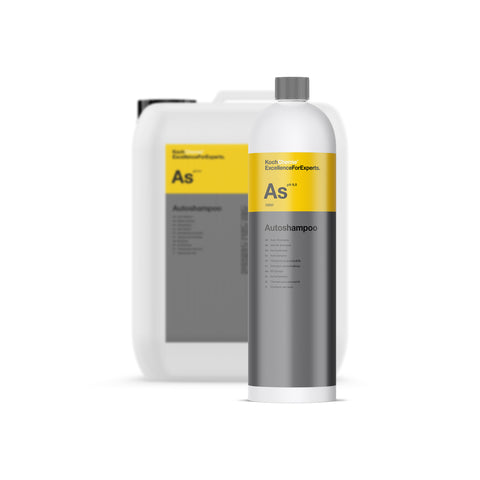
The Gentle Snow Foam covers the pH-neutral foam stage; one customer uses it after ceramic coating. For the contact wash, the Koch-Chemie Autoshampoo "As" follows. If you want to compare other brands, you'll find GYEON Q²M Bathe, TUGA Chemie Shampoo-Teufel® and Meguiars Ultimate Wash & Wax among others, and for foams, SONAX PROFILINE ActiFoam "Energy", for example.
For special cases there are specialists: the Koch-Chemie Reactivation Shampoo "Rs", an acidic shampoo for ceramic-coated cars that dissolves deposits like limescale and salt, the Koch-Chemie Pre-Foam efficient "Pfe" as pre-cleaner and bug remover, and the Rapid Rinseless Wash for washing without rinsing. Bucket, lid and grit guard together come as the Koch-Chemie Detailing Bucket Set (wash bucket, lid and grit guard).
You don't need a pressure washer for the pre-wash. A pump foam sprayer like the solo CLEANLine "VARIOfoam" (304 FA / FB) builds up pressure with the hand pump, and you rinse off with the hose afterwards. For drying the panels, one big towel like the THE COLLECTION "Aqua" Twisted Loop Drying Towel (1500 GSM) will do.
How much kit you need depends on where you wash, how dirty your car gets and what paint protection is on it — not on a fixed shopping list.
If you regularly use a well-kept automatic car wash, you don't need much. The ADAC rates washes with foam and with needled textile brushes as equally suitable. A pre-cleaner from a spray bottle before you drive in is a sensible addition if the car wash doesn't offer a pre-wash itself, the operator allows it and you drive in straight afterwards, before anything dries on.
With your own permitted wash spot, a basic kit per step is enough to start with: one pre-wash product, one shampoo, one wash mitt, two buckets (shampoo solution and clean water), one of them with a grit guard, and one big drying towel, plus a separate mitt or brush for the wheels. Add more once you notice where your routine snags.
If your paint is sealed, go pH-neutral for everyday washing. According to Koch-Chemie, acidic special shampoos like the Rs are used on ceramic-coated surfaces specifically against deposits like limescale and salt. With a pre-cleaner, it's worth checking what your sealant is approved for. Alkaline means the solution sits above pH 7 and cuts hard through grease and road film. For you, that means: depending on the product, it can also attack paint protection. Which routine suits a city car, a high-mileage driver or a ceramic coating is described on the car wash page.
In winter, road salt stays on the paint until you wash it off, and the ADAC flags it as critical above all for already damaged paint. According to Google Trends, “Auto waschen” (washing the car) is searched most in April and least in autumn. Put off the first thorough wash until spring and you leave the salt sitting on the paint for months.
How much effort drying takes is ultimately down to your water supplier. It publishes the hardness range of its water at least once a year: soft below 1.5, medium 1.5 to 2.5 and hard above 2.5 millimoles of calcium carbonate per litre — roughly below 8.4, up to 14 and above 14 degrees of German hardness.
That number describes how much dissolved limescale is in every droplet that evaporates on your paint. What that means for you: from “hard” upwards, take off the leftover water immediately and completely, or do a final rinse with soft water. Know your hardness range and you'll know before the first drop how thoroughly you need to dry.
Too much choice in Washing? Get help picking:
Use a product for each stage: a pre-wash cleaner or Snow Foam for pre-washing, car shampoo with a mitt and bucket for the contact wash, and a large drying towel to finish. We do not recommend household substitutes, because they lack manufacturer guidance on compatibility with paint and its protection.
Start with the wheels using separate equipment, let the pre-wash dwell and rinse it off, then shampoo from the roof down. Finish by rinsing and drying. Rinse the mitt in clean water after each section. Work in shade on cool paint. Our guide to washing your car properly without swirls covers the full process.
For many drivers, a well-maintained automatic car wash is enough. ADAC considers foam and needle-punched textile systems equally suitable and recommends pre-washing because sand otherwise acts like sandpaper. Hand washing is worthwhile if you want control over wheels, edges and gaps, and want to choose your products, such as a pH-neutral wash for your coating.
In Germany, your municipality decides, usually through wastewater regulations. Many areas ban washing on private property; others often allow it only on paved ground connected to the foul sewer, never on unsealed ground. Without permission, use a self-service bay or automatic car wash. Building rules and your municipality decide whether rinseless washing is allowed in your parking space.
Yes, with care. ADAC advises against automatic car washes below minus ten degrees, because warm wash water stresses paint, rubber and plastic on a cold car. Remove snow and ice before washing. Road salt still needs washing off: ADAC identifies it as a concern especially for already damaged paint.
Water spots form when water evaporates on paint and leaves its minerals as limescale. Wash in shade and remove the remaining water promptly. Your supplier's hardness rating shows how much limescale your water contains; with hard water, a final soft-water rinse is worthwhile. Read more in our guide to preventing water spots on car paint.
Daniel von Detailing1 |

Jasper von Detailing1 |

Daniel von Detailing1 |

Daniel von Detailing1 |

Daniel von Detailing1 |

Jasper von Detailing1 |

Jasper von Detailing1 |

Daniel von Detailing1 |

Daniel von Detailing1 |

Daniel von Detailing1 |

Daniel von Detailing1 |

Daniel von Detailing1 |


