



5 leather brush mistakes that roughen car leather
Daniel von Detailing1 |


SONAX
PROFILINE MultiClean "Alkaline" Pre-Cleaner
MultiClean "Alkaline" — Pre-cleaner for professional pre-wash


GYEON
Insect Remover – dissolves dried-on insects without scratching


Soft99
Ultimate stain remover for effective car care
servFaces
Reactive Cleaner (High-Concentrate) Pre-Wash
GYEON Q²M Tar (REDEFINED) softens the drops in two minutes.

Fresh, a pre-cleaner lifts it. Later the etch mark stays in the clear coat.

Message us on WhatsApp, we recommend based on wheel and grime.
What does a pre-cleaner do on a car? It chemically breaks down the grimy film of road dust, bug remains, brake dust and oil mist before the pressure washer rinses it away. Whatever runs off at this stage never ends up under your wash mitt, so it can't scratch the paint.
Pre-cleaners are alkaline or acidic cleaners for the first, touchless step of a car wash. You spray them onto the wet car, let them dwell for a few minutes and rinse them off before a sponge or wash mitt even touches the bodywork. The point isn't a clean car, it's cutting risk. Whatever the pre-cleaner takes away can't drag scratches in during the actual wash.
Detailing1's tip from the shop: The most expensive mistake in this category is always the same one, and it has nothing to do with the product. The pre-cleaner gets sprayed onto dry paint that's been baking in the sun and dries on before you can rinse it. What's left are streaks and edges, and with acidic products on aluminium wheels even dull spots that only polishing will fix. Flood the car with clean water first, work in the shade on a cool surface and spray from the bottom up so runs don't cut clean tracks through the dirt. Then rinse from the top down. We regularly see exactly this one step, the pre-rinse, skipped to save time – and it costs you the whole pass.
The pre-cleaner takes off the hard part of the dirt before any fabric touches the paint for the first time. Whatever runs off here can't grind later.
Road dust isn't powder, it's a mineral mix with a high quartz content. Quartz is more than twice as hard as cured clear coat. Put simply: every speck of dust on the bonnet is a piece of grit. Day to day that means the trick isn't wiping extra gently, it's leaving as little as possible to wipe in the first place.
That's why swirls rarely come from the wash mitt itself. They come from whatever it drags across the panel. A car that goes under the mitt without a rinse picks up a fine web of scratches with every wash, and it only shows months later as a fan pattern when low sun rakes across the paint.
Specifically, the pre-cleaner tackles four groups of dirt: traffic film made of dust, tyre wear and oil mist; dried bug remains on the front, mirrors and mirror bases; the brake-dust haze on the lower doors; and in winter, loose salt crust. The rest – that last wafer-thin greasy film – is deliberately left to the shampoo.
That also marks the limit. A pre-cleaner doesn't replace the wash, and if you run a finger over the paint after rinsing you'll still feel drag. We get plenty of questions on exactly this point, usually hoping to skip contact altogether. Prepping touchless and then washing with minimal contact remains the realistic goal.
A pre-cleaner differs from a foam wash in its role, not in how it works. Foam is just a carrier that keeps the chemistry on vertical panels for longer. What you put in the lance decides the effect. How the two steps fit together is covered in Snow Foam and in the overview of car washing.
The most important number on a pre-cleaner is rarely printed big on the label. It's the pH, and it decides which dirt the product can even attack.
Alkaline pre-cleaners work at around pH 11 to 13. Alkalis saponify fats, making them water-soluble by breaking the long fat molecules into soap-like fragments. In practice you notice it when the grey oil-mist haze around the wheel arches is simply gone after rinsing, without you touching it. SONAX PROFILINE MultiClean „Alkaline" Pre-Cleaner is typical of this type.
Acidic pre-cleaners sit at the other end, usually between pH 1 and 3. Acids dissolve anything mineral: limescale from hard tap water, cement haze from building sites and dried-in water spots. SONAX PROFILINE MultiClean „Acid" Heavy-Duty Cleaner (Acidic) is the counterpart, and for spot limescale on glass and paint you reach for GYEON Q²M WaterSpot Limescale Remover.
In between sit two specialists that don't fit neatly into either group. Iron removers like GYEON Q²M Iron (REDEFINED) Iron Remover bind embedded brake dust into water-soluble complexes and show it by bleeding purple. So you watch live where the fallout sits, no guesswork needed.
Tar and tree sap don't react to either route, because they're neither greasy nor mineral but resinous. For those you need a solvent-based product like GYEON Q²M Tar (REDEFINED) Resin & Tar Remover, which softens the resin structure rather than breaking it apart. Use it on spots, never across the whole car.
One rule applies across all types: never acidic and alkaline on the same wet surface at the same time. They neutralise each other, and you end up with salt and water instead of cleaning power. Between two different products there's always a full rinse with clean water.
Chemistry needs time. The most common reason for a disappointing result isn't the wrong product, it's a thirty-second dwell.
A pre-cleaner has to creep under the dirt film before it can lift it. The surfactants migrate to the boundary between paint and dirt and undermine the bond, and that happens by diffusion. You can't speed diffusion up by laying down more product. It simply takes minutes. Three to five is the usual window.
Too short means half the effect. Too long means it dries on, and a pre-cleaner that dries on is worse than none at all, because the loosened dirt bakes back on and the concentration climbs as it evaporates. So only spray as much area as you can rinse off again within the dwell time. In the heat that means one side of the car, not the whole thing.
Temperature cuts both ways. Warm paint speeds up the reaction, and it speeds up evaporation just as much. What can sit for five minutes in the cool of the morning is dry after two in the afternoon. A cool surface and shade aren't a comfort thing, they're part of the dosing.
Dilution is the second lever. With Koch-Chemie PreWash express „Pe" Pre-wash and Koch-Chemie Pre-Foam efficient „Pfe" Pre-Cleaner & Insect Remover, the mix controls how strong the pass is. What we see day-to-day: a second mild pass almost always beats one highly concentrated pass, because round two works on dirt that's already loosened.
And to set expectations: the first time, a mid-size car will take you about twenty minutes, just because pre-rinsing, spraying and rinsing in sections feels unfamiliar. By the third pass you're down to ten. The difference is routine, not skill.
The process is short, and the order is non-negotiable. Every step exists because something goes wrong without it.
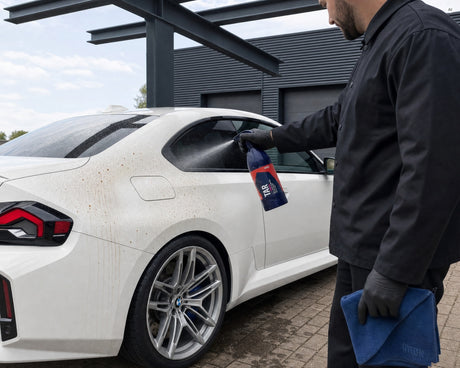
First, flood the dry car completely with clean water. That takes the loose sand with it that would otherwise sit in the foam later, and it cools the surface. Wet paint also dilutes the incoming cleaner evenly, instead of letting it stand concentrated in spots.
Then apply from the bottom up. The reason is subtle and the effect immediate: if the cleaner runs down over still-dirty paint, it cuts clean streaks that dwell for different times when you spray again and stay visible as shadows. Working from the bottom, it runs over surface that's already wetted.
Foam lance, pressure sprayer and a simple pump sprayer all do the job. The lance gives you the biggest advantage on vertical panels, because the foam clings there instead of sliding off in seconds. GYEON Q²M Foam Snow Foam is built for that, and GYEON Q²M APC All-Purpose Cleaner also covers door shuts, wheel arches and floor mats.
Rinse from the top down, keeping your distance at a flat angle. A pressure jet held too close drives water behind trim and seals, where it sits for days and trickles back out on the next sunny day. Bare and anodised aluminium parts are sensitive too – never let alkaline cleaners dry on them.
After rinsing, go straight into the two-bucket hand wash or add a foam pass as a buffer. Which Car shampoo goes in the bucket depends on whether your paint is sealed. For boats and motorhomes the same system exists as a separate marine line with alkaline and acidic hull pre-cleaners.
Two manufacturers make up the lion's share of this category, and they go about it very differently. The rest is split between SONAX, INNOVACAR and Soft99.
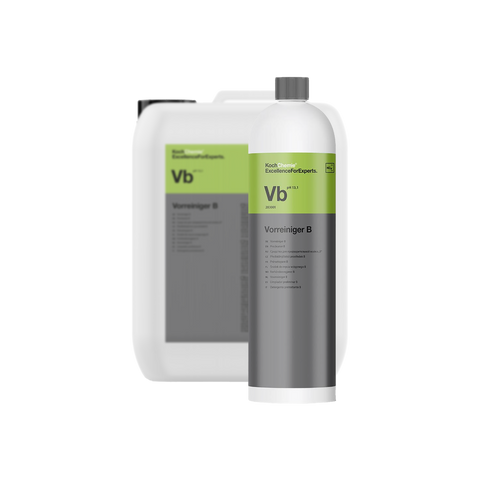
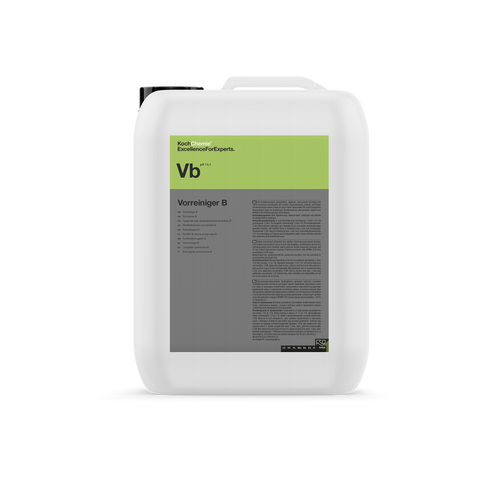
Koch-Chemie thinks in concentrates and in jobs. Vorreiniger B „Vb" is the workhorse for everyday traffic film and our clear best-seller. Koch-Chemie Pre-Wash B „Pb" Pre-Cleaner & Bug Remover goes after insect protein, which simply needs a different attack than dust and oil.
GYEON thinks in decontamination stages. The Q²M line is built like a modular kit where each product takes on exactly one type of contamination: iron, tar, limescale, general dirt, foam. If you want to keep clear which step fixes which problem, this is the tidiest structure in the range.
With PROFILINE MultiClean, SONAX covers the alkaline/acidic pair and puts the pH logic right there on the shelf. Both versions are the same idea pointed in two directions, which makes the choice easy once you know what dirt you're facing.
For getting started without concentrate maths, there's INNOVACAR „SP1" Prewash Pre-Wash Car Shampoo. It deliberately sits between pre-wash and shampoo and is the pragmatic answer if you look after one car and don't want two jerry cans in the cupboard.
Prep also includes the mechanical stage. Clay bar and clay sponge come after the chemistry and before polishing, when something is still sitting on the paint after rinsing that you can feel with a fingernail. Chemistry first, mechanics second – in that order the clear coat stays intact.
The choice comes down to three questions: how do you drive, how hard is your water, and what's sitting on your paint.
For a car in normal commuter use, washed every two weeks, a standard alkaline pre-cleaner is all you need. Traffic film is exactly what these products are built for, and nothing more is required. Reaching for the acidic heavy-duty cleaner here means buying a tool for a problem you don't have.
Long summer drives shift the balance. Bug remains are proteins; after a few warm hours they're properly stuck and, if you go at them mechanically, they leave the front covered in fine scratches. A pre-cleaner geared towards bug removal is then the more important buy, and it's worth a look at Insect remover too.
With hard tap water or after a drive through roadworks, the acidic side takes priority. Limescale and cement haze don't react to any alkaline cleaner, however strong you mix it. What counts here is the right type, not the dose, and you keep application short and to the spot.
If your car wears a ceramic coating, go gentler. Strongly alkaline pre-cleaners at the top of the pH range shorten the coating's lifespan with every pass. Mix the concentrate weaker, keep the dwell short and rinse thoroughly. Whatever cleaning power you give up, the low-contact wash afterwards makes up for.
And if you're just starting out: a ready-to-use or easy-to-mix product plus a pressure sprayer will see you through your first summer. The finer points – iron remover, tar remover, limescale remover – come later, the first time you notice something still left after rinsing. The bigger picture is under car washing, the foam step under Snow Foam.
Too much choice in Pre-cleaner? Get help picking:
Daniel von Detailing1 |

Jasper von Detailing1 |

Daniel von Detailing1 |

Daniel von Detailing1 |

Daniel von Detailing1 |

Jasper von Detailing1 |

Jasper von Detailing1 |

Daniel von Detailing1 |

Daniel von Detailing1 |

Daniel von Detailing1 |

Daniel von Detailing1 |

Daniel von Detailing1 |


