


5 leather brush mistakes that roughen car leather
Daniel von Detailing1 |


Koch-Chemie
Applicator Sponge for Plastic, Rubber & Leather Care

Koch-Chemie

Koch-Chemie
Magic Eraser Specialist Sponge


GYEON
Q²M WashPad EVO microfibre wash pad (1250 GSM)
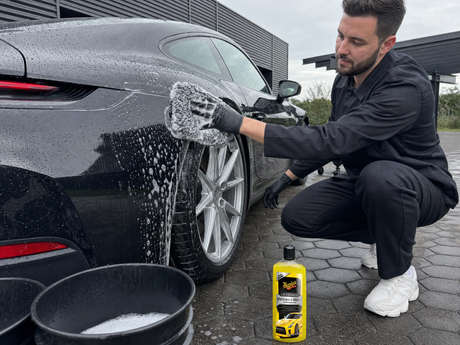
Shampoo, mitt and two buckets belong together.


Koch-Chemie × COLOURLOCK
COLOURLOCK "Cleaning & Application Sponge"
INNOVACAR
"White Sponge" melamine dirt eraser (pack of 10)
Melamin-Schmutzradierer für hartnäckigen Schmutz, nur Wasser


QJUTSU
Revolutionary car wash with three-layer special sponge

Message us on WhatsApp and we will put your kit together.
What do you need a wash sponge for on your car? For wheels, wheel arches, sills and tyre sidewalls, where heavy dirt sits and the paint won't suffer. On painted surfaces the wash mitt is the safe choice, because it picks particles up instead of pushing them around.
Wash and cleaning sponges for your car are foam sponges that soak up water and shampoo and release it again as you wipe. Their surface is smooth and flat, so loosened dirt stays trapped between sponge and panel. That makes a sponge strong on tough parts like wheels, wheel arches, sills and tyre sidewalls — and second choice on clear coat, where a long-pile wash mitt pulls particles away from the surface.
Detailing1's tip from the shop: We often get questions about fine scratches that suddenly show up on the bonnet after a careful wash. Almost every time, the same sponge had been on the wheels shortly before. Brake dust is made of iron filings and mineral grit, and that mix stays in the foam even if you wring it out hard. Use a separate sponge for wheels and tyres, ideally in a different colour, and do the wheels last. If a sponge ever drops on the ground, from then on it goes in the wheel arch bucket and never back to the paint.
A sponge doesn't pick dirt up — it pushes it along. That's exactly what creates the fine scratches you later see as swirls across the bonnet under direct light.
The reason is in the surface. A classic wash sponge is largely smooth and closed on the outside, with its pores on the inside. A grain of sand you catch with it has nowhere to go. It stays in the gap between foam and clear coat and travels along with every pass.
A wash mitt works the other way round. Its long microfibre or wool pile stands over the surface like a dense forest, and loosened particles drop down between the fibres. What that means for you: the dirt leaves the contact zone instead of staying trapped in it and riding along.
What happens there is pure mechanics. A single grain of quartz is harder than clear coat and, as you wipe, carries your entire hand weight on an area of a few hundredths of a millimetre. Half a second of contact is enough for a mark that'll annoy you on the next sunny day.
These marks are called swirls because they show up in sunlight as a circular haze around the reflection. You'll spot them first on dark and solid-colour cars; on white and silver, the same scratches barely show. The only way to get rid of them is polishing — in other words, taking off clear coat.
So the sponge isn't a bad tool. It's a tool for surfaces where this mechanism doesn't matter. For painted panels, reach for a mitt from Washing gloves, and wherever scratches have no consequences, the sponge stays the faster and cheaper solution.
Wherever heavy dirt sits and the surface doesn't need to be show-car glossy, the sponge plays to its strengths.
The wheels come first. Brake dust, road film and old tyre dressing residue stick hard here, and the gaps in the spoke pattern call for something you can squeeze and push through narrow spokes. A sponge folds; a mitt jams in the same spot.
The wheel arch is the second place. The plastic there is textured, dark and already marked by stone chips anyway. Fine scratches stay invisible, but dried-on road grime is tough, and a sponge brings water and cleaner to the surface in amounts no cloth can hold.
Sills and door shuts benefit for a different reason. Salt and scuffs from shoes collect there in a narrow channel, and the edge of the sponge follows that shape neatly. One limit still applies: the visible paint on the sill belongs to the mitt; the sponge works in the channel.
The tyre sidewall is the fourth classic, and the most rewarding. Rubber can take pressure, old dressings sit on it as a grey film, and only a properly clean sidewall takes new Tire care evenly. Skip that step and you'll find brown streaks on the ground the next morning.
Then there are the areas hardly anyone thinks about. Rubber floor mats, the boot sill, the underside of the tailgate and the fuel flap surround are all tough, all dirty and all awkward to reach with a cloth. A small sponge with a clean edge gets through there in one go where you'd otherwise be wiping three times.
One thing we see day-to-day: for these four zones you don't need one sponge, you need several. The sponge from the wheels never goes on the sills, and the one from the tyre sidewall never goes back to the wheels. Separate sponges are cheaper than any polish.
Three types share the field, and they differ less in material than in the structure of their surface.
Closed-cell sponges have fine, separate cells. They take up little water, release it in a controlled way and feel firm. In practice: good for applying dressings, weak at washing, because loosened dirt can't find its way inside.
Open-cell sponges are a connected network of struts on the inside. They soak themselves full like a sponge in the literal sense and release lots of water under pressure. The advantage is in rinsing: squeeze the body out in the bucket a few times and you actually get some of the dirt out of the inside.
Melamine foam is the third type and works on a completely different principle. The foam, made from cured melamine resin, consists of microscopically hard struts and acts like extremely fine sandpaper that wears itself away as you work. Put simply: it erases dirt rather than dissolving it chemically.
That's exactly why melamine has no business on clear coat, glass or piano black. Its place is textured plastics, sooty edges, stubborn marks on sills and rubber surfaces. Testing on a hidden spot first isn't a throwaway line here — it's the difference between clean and permanently dull.
Besides the cell type, shape decides how it works day to day. A body with bevelled corners gets into edges and shuts, a flat block spreads the pressure evenly across your palm, and a grippy back stops the wet thing slipping out of your hand every other pass. Sounds minor, but it decides whether you end up working with your fingertips or the whole surface.
Then there are application sponges, which neither wash nor erase. They're small, hold their shape and are designed to spread plastic or leather care thin and evenly. That area has its own section with us under Applicators.
When the sponge comes out, three things decide the result: the pre-wash, the number of buckets and discipline when rinsing.
Before any contact, rinse the surface. Sand, road salt and brake dust sit loose on top, and whatever the water jet has already knocked off can't ride along under the foam later. With heavy soiling, a pre-cleaner or a thick foam goes first.
Then the two-bucket wash. One bucket holds the shampoo solution, the second just clean water for rinsing. After every pass, the sponge goes into the rinse bucket first, gets squeezed out there, and only then goes back into the shampoo. That way the dirt stays in the rinse water and not in the wash solution.
A grit guard boosts the effect. It's a grid insert at the bottom of the bucket that you scrub the sponge against, with the loosened sand collecting underneath. You'll see it for yourself: after the wash there's a clear layer on the bottom that, without the grid, would have come back up the next time you dunked.
Work from top to bottom and keep the zones separate. Wheels and wheel arches are the dirtiest areas on the car and come last, with their own sponge and their own bucket. Coloured sponges help, because you can see which is which instead of having to remember.
After the job, rinse the sponge thoroughly and store it dry. Foam squeezed up while damp smells after two days, and a grain of sand left inside is exactly the scratch you wanted to avoid next time round. The first time, the routine feels fiddly; by the third wash it runs on autopilot.
Our selection is deliberately tight, and every item in it has a clearly defined job.
The Koch-Chemie Car Care Wash Sponge is the classic of the category. Big, open-cell body, lots of water uptake, comfortable in the hand. Its place is the wheels, wheel arches and tyre sidewalls, and there it replaces a whole pile of cloths.
The Koch-Chemie Sponge is the smaller, firmer version for detail work. It fits between spokes, into door shuts and along edges where a big sponge could only work with its corner.
The Koch-Chemie Magic Eraser Specialist Sponge is the melamine option in the range. It shifts marks on sills, shoe scuffs on plastic sill covers and grey shadows on textured surfaces. It has no place on paint or glass, and that's a limit we'd rather mention once too often.
For the interior, there are two specialists. The Koch-Chemie Interior Scrubber Interior Cleaning Pad is the best-seller in this area and brings enough bite on textiles, headliner and plastic without rubbing the grain shiny. The SONAX PROFILINE Interior Sponge „Duo" Application Sponge combines a soft side and a grippy side, so cleaning and spreading happen without switching tools.
A word on lifespan, because the question comes up regularly. A sponge is a consumable, not a tool for life. As soon as the surface is roughed up, corners are missing or particles have worked their way in for good, it's done for anywhere near paint and moves on to wheel arches and tyre sidewalls. The price of a replacement is nothing next to a polish.
If you're after the bigger picture, you'll find the whole area under Sponges, applicators & cleaning pads. The clay sponges under Claying tools sit alongside on purpose, because despite the name they're not a washing tool — they're for decontamination before polishing.
The decision hangs on a single question: is the surface painted and on show, or is it tough and already marked anyway?
If you want to wash your whole car, the sponge isn't the tool for the bodywork. For that, use a mitt from Washing gloves and keep the sponge in reserve for the wheels and lower edge of the car. That split costs you one extra move and saves you a polish come spring.
If you're only after wheels and tyres, one big open-cell wash sponge plus a small one for the gaps is enough. The combination of Koch-Chemie Car Care Wash Sponge and Koch-Chemie Sponge covers both sizes, and both can get as ugly as they like.
For stubborn marks on sills or plastic sill covers, no normal sponge will get you there. The Koch-Chemie Magic Eraser Specialist Sponge is the answer, with the clear caveat that it only goes on matt and textured surfaces.
For the interior, choose by task. Cleaning with pressure on textiles and plastic is a job for the Koch-Chemie Interior Scrubber Interior Cleaning Pad; spreading dressings evenly calls for a soft application sponge from Applicators.
And if you're not sure, the simple rule from everyday life at Detailing1 applies: when in doubt, the sponge goes low and the mitt goes high. Anything you admire in the sunlight gets washed with pile. Anything that takes stone chips anyway gets clean faster and cheaper with foam.
Too much choice in Wash and cleaning sponges? Get help picking:
Daniel von Detailing1 |

Jasper von Detailing1 |

Daniel von Detailing1 |

Daniel von Detailing1 |

Daniel von Detailing1 |

Jasper von Detailing1 |

Jasper von Detailing1 |

Daniel von Detailing1 |

Daniel von Detailing1 |

Daniel von Detailing1 |

Daniel von Detailing1 |

Daniel von Detailing1 |


