



5 leather brush mistakes that roughen car leather
Daniel von Detailing1 |


Koch-Chemie
Koch-Chemie
Koch-Chemie Reinigungsknete "Rkb" Mild "Blau" Clay Bar
Gentle cleaning for paint and glass with detailing clay
Koch-Chemie
Cleaning Clay "Rkr" Abrasive "Red" Clay Bar
Abrasive cleaning clay for heavily soiled paints
The Rag Company
Effective paint cleaning and ideal preparation for wax and polish.

Meguiars
SMOOTH SURFACE Clay Bar Replacement Detailing Clay
Replacement Detailing Clay for Sensitive Clear Coats

Soft99
High-quality cleaning clay for optimal vehicle care
Koch-Chemie


SONAX
Clay Knetmasse — Profi-Knete für kratzerfreie Lackdekontamination

Meguiars
HYBRID CERAMIC Synthetic Clay Kit Clay Bar
Synthetic Clay Pad + Ceramic Detailer + Microfiber Cloth — 1 Set

Soft99
Professional cleaning clay for deep paint care


Meguiars
SMOOTH SURFACE Clay Kit Cleaning Clay
Complete Clay Bar and Lubricant Detailing Kit

Clay bar pulls out embedded particles that shampoo cannot lift

SONAX
PROFILINE ClayDisc "150" clay pad
Clay Disc "150" — Machine Clay Pad for DA Polishers
What does cleaning clay do? It pulls embedded particles out of the clear coat that you can still feel after washing. The key is the lube film between clay and paint. At Detailing1 you'll find mild and aggressive clays, clay pads, clay sponges and the matching lubricants.
Cleaning clay is a mouldable synthetic elastomer that glides over the paint on a film of lubricant and picks up anything sticking out of the surface. Tree sap, industrial fallout, brake dust grains and paint overspray stay stuck in the clay instead of being dragged across the clear coat. It's the mechanical part of decontamination and sits between washing and polishing.
Detailing1's tip from the shop: If you drop your clay on the floor, it's rubbish. It picks up sand and grit into its surface, and no amount of rinsing gets those grains back out. Keep using it anyway and you're dragging a piece of grit across the clear coat with every pass. What we see day-to-day: that's the most common reason for deep scratches after claying. So work with a third cut off the bar, and a slip only costs you a small piece.
After the wash the paint is clean, but still not smooth. Whatever feels rough under your fingertips is sitting in the surface, not on it.
The biggest share is industrial fallout: fine metal dust from brakes, railway lines and nearby industry. The particles hit the clear coat hot, sink in slightly and then sit there as firmly as a hammered-in nail head.
Then there's the organic part. Tree sap, bug remains and pollen glue dry into hard little bumps that survive every wash. Chemicals can soften them, but what's left stays put until something lifts it mechanically off the surface.
The third group is building-site fallout: overspray from painting work, cement haze, limescale splashes from someone pressure-washing their paving. A car that spent a week next to a renovation feels like fine sandpaper on the bonnet.
The next job shows why that can't stay there. Every one of those grains is harder than the abrasive in your polish. Once it gets under the pad it turns into a cutter and drags a trail right across the panel.
How often you need to clay depends on where the car lives. A car in a carport or under cover usually needs it once a year. Park next to railway tracks, a metalworks or a never-ending building site and you'll feel grit under the bag again after six months.
One limit we often have to spell out: clay only removes what sits above the paint surface. Swirls, scratches and the etched rings from bird droppings sit below that surface, and no amount of claying changes that. That kind of damage needs a machine polisher, not clay.
The amount of lube is the only factor that really decides the result when claying. Everything else is comfort.
The mechanics are simple. The clay glides on a film of liquid and picks up particles as they sink into the soft material. If the film dries away, the grain you've just picked up gets pressed between clay and clear coat. From that point you're sanding, not cleaning.
In practice the panel has to stay wet and glossy from the first pass to the last. As soon as an area goes dull, give it another spritz straight away. Several top-ups for half a roof are normal, and too much lube has never damaged paint.
Dedicated lube is made for this. Koch-Chemie Clay Spray „Cls" Clay Lube for Decon Clay is our best-selling item in this category, and GYEON Q²M ClayLube (REDEFINED) Clay Bar Lubricant is the pick for sealed cars. D-CON Clay-Lube Clay Bar Lubricant Spray and INNOVACAR „DL" Lube Clay Bar Lubricant Spray do the same job.
Shampoo water from the bucket works in a pinch, with one drawback: the surfactant film breaks down sooner and you notice later. If you go that route, spray twice as often and work smaller sections.
Be generous with how much you plan to use. Worked properly, a saloon easily goes through half a litre bottle of lube, and a heavily contaminated car can take more. Skimping on lube is the most expensive saving in this category, because the rework happens on the polishing machine.
Resistance is your sensor. The first two passes grab audibly, after that the clay has to glide easily. If it keeps dragging, sticks or squeaks, you need more lube. We get lots of questions about swirls after claying, and almost every time the panel went dry somewhere along the way.
Three designs do the same job at different speeds, with different levels of feel and different tolerance for mishaps.
The classic clay bar is the most precise tool. You mould it around swage lines, edges and mirror bases, fold it fresh after every section and feel every single grain through the thin clay. The price is how unforgiving it is if it hits the floor.
The clay pad flips the principle: a polymer layer on a foam backing that you use by hand or on the polishing machine. Koch-Chemie Clay Pad and SONAX PROFILINE ClayDisc „150" clay pad get through large, flat areas in a fraction of the time and can be rinsed out under running water.
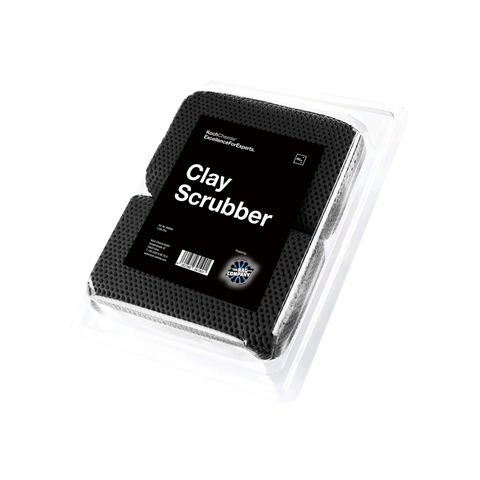
Clay sponge and clay towel sit in between. Koch-Chemie Clay Scrubber Sponge carries its polymer layer on a grippy backing, covers a wide strip in one pass and is especially easy to handle on glass and wheels.
Lifespan is where the group splits clearly. A clay bar gets used up because you keep folding away surface until nothing clean is left. Pads and sponges last for many cars, as long as you rinse them thoroughly after each use and store them dry.
On a polishing machine, pads have their own rule. Low speed, no pressure, and the panel has to be even wetter than when working by hand. A pad spinning on dry paint leaves a marring pattern within seconds that costs you a full polishing round.
What we see day-to-day: the combination works best. Pad or sponge for roof, bonnet, boot and door panels, clay bar for sills, wheel arch edges and everything around trim. Use both together and you save time without losing feel in the tricky spots.
Clays differ in how aggressive their formula is, and that choice decides how much rework follows.
The mild group is the standard for well-kept cars. Koch-Chemie Reinigungsknete „Rkb" Mild „Blau" Clay Bar works its way over the paint almost without a trace on a clean lube film and is the right answer for the yearly round before sealing.
Aggressive clays bite harder. Koch-Chemie Cleaning Clay „Rkr" Abrasive „Red" Clay Bar pulls sintered-on fallout and overspray off neglected paint and leaves fine marring – a dull grey haze in raking light. It belongs on cars that get polished afterwards.
Meguiars SMOOTH SURFACE Clay Bar Replacement Detailing Clay covers the ready-to-use middle ground and works as a refill when an existing kit only has lube left.
Rule of thumb: the mildest clay that gets the panel smooth in two passes. Two calm passes with a fine clay cost ten extra minutes and save you a full polishing round.
On dark paint this choice shows. Black and dark blue reveal every bit of marring in raking light, while the same treatment on silver stays practically invisible. Clay a dark car aggressively without polishing afterwards and you swap roughness for a dull haze.
The material limits are clear. On glass you can work more aggressively, and on plastic and chrome it works just like on paint. With matte paint and wraps, check with the manufacturer first – neither surface forgives marring, because you can't polish it out.
The process is short, and it doesn't forgive shortcuts in the prep.
Before the clay comes the full wash, then the chemistry. First the Rust remover, then the tar remover, and only once both are rinsed off does the mechanical tool come in. Every particle the chemistry has already dissolved no longer ends up in the clay.
The clay itself gets prepped, not just unwrapped. Cut off a third, warm it between your palms and press it into a flat patty about the size of your palm. Cold clay is stubborn and tears; hand-warm clay lies softly over the panel.
Work on panels that are cool to the touch, in the shade, only half a panel at a time. Spray generously, pull straight overlapping passes with no pressure, then go across in the other direction. The clay carries its own weight – pressing down adds nothing but risk.
After each section, fold the clay over and knead it again until the contact face is clean. If you see dark specks on it, that moment has already come. Stay on the same side too long and you'll drag the dirt you've just lifted across the next section.
Two zones regularly get skipped, and they're also the most contaminated: the lower doors below the trim strip and the areas right behind the wheel arches. That's where most brake dust collects, and that's where an extra pass pays off most.
Finally, wipe off the residue, rinse and dry. The paint is now unprotected and needs polish or a sealant straight after. The first time, a mid-size saloon takes about ninety minutes; by the third time it's forty-five. That gap is normal and no sign of clumsiness.
The choice comes down to three questions: how contaminated is the paint, how much area are you treating, and will you polish afterwards.
For a regularly maintained car that gets fully decontaminated once a year, mild clay plus a dedicated lube spray is the right answer. Koch-Chemie Reinigungsknete „Rkb" Mild „Blau" Clay Bar together with Koch-Chemie Clay Spray „Cls" Clay Lube for Decon Clay is our best-selling pairing.
On a used car with paint that's gone untouched for years, the faster route is a pad. SONAX PROFILINE ClayDisc „150" clay pad handles the large areas, and a polish follows anyway to take out any marring.
If you're claying for the first time, grab a matched kit. Meguiars HYBRID CERAMIC Synthetic Clay Kit Clay Bar comes with clay and lube in matching quantities, so your first bonnet doesn't fail on the wrong ratio.
If it's mainly about glass and wheels, Koch-Chemie Clay Scrubber Sponge is the more comfortable tool. It sits firmly in your hand, doesn't slip on wet glass and takes off the baked-on film along wiper edges that no glass cleaner shifts any more.
One honest caveat to finish: clay has no business on a fresh ceramic coating. It wears the layer away in spots, and you pay in durability for a bit of slickness. Claying goes before the coating, never after. For maintenance rounds in between, the range under Paint cleaning has you covered.
The full route from washed to polish-ready paint is under Paint preparation, and everything for the step after that under polishing. Within that, clay is the short stage that makes every later job better and can't be replaced by anything else.
Too much choice in Cleaning clay? Get help picking:
Daniel von Detailing1 |

Jasper von Detailing1 |

Daniel von Detailing1 |

Daniel von Detailing1 |

Daniel von Detailing1 |

Jasper von Detailing1 |

Jasper von Detailing1 |

Daniel von Detailing1 |

Daniel von Detailing1 |

Daniel von Detailing1 |

Daniel von Detailing1 |

Daniel von Detailing1 |


