


What a car leather sealant protects and what it doesn't
Daniel von Detailing1 |


Koch-Chemie
Exterior Wash Mitt 640GSM Microfibre Wash Mitt

Koch-Chemie
Microfibre Mitt Set "Octopus" Wash Mitt

Koch-Chemie
D-CON
Chenille Wash Mitt Microfibre Wash Glove
Absorbent, scratch-free, and lint-free chenille wash mitt
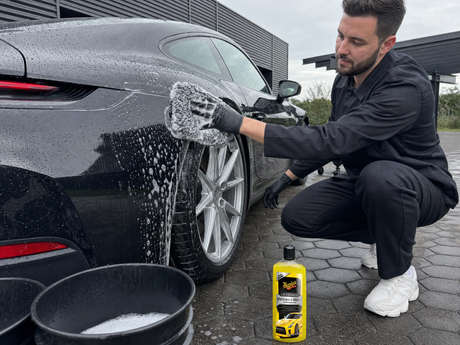
Shampoo, mitt and two buckets belong together.
The Rag Company
Special microfiber blend for efficient and safe cleaning


The Rag Company
The Cyclone Ultra Microfibre Wash Mitt
Special microfiber blend for efficient and safe cleaning

GYEON
Q²M Smoothie EVO Microfibre Wash Mitt (1250 GSM)


Meguiars
Paint-friendly microfiber wash mitt for hand washing
INNOVACAR
"Micron Wash Mitt" Microfibre Wash Mitt
Beidseitiger Mikrofaser-Waschhandschuh, super saugfähig
TUGA Chemie
Wash Mitt (Microfibre) for "Shampoo-Teufel"
Microfibre wash mitt with internal seam for two-bucket hand washing


GYEON
Q²M WheelMitt EVO microfibre wash mitt for wheels (1250 GSM)


Meguiars
Microfiber Wash Mitt with Long Pile for Hand Washing
What does a wash mitt do for your car? Its long pile pulls sand and brake dust deep inside and keeps both away from the paint. At Detailing1 you'll find lambswool, microfibre and chenille, plus a second mitt for sills and wheels.
Washing gloves for cars – wash mitts, as detailers call them – are hand-wash tools whose long pile of wool, microfibre or chenille yarn carries loosened dirt away from the paint and deep into the material. It stays there until you wring the mitt out in the rinse bucket. A smooth sponge can't do that: it has no storage space. It drags every grain of sand under its own surface across the clear coat, and that's exactly where swirls come from.
Detailing1's tip from the shop: We often get questions about mitts that turn hard and scratchy after a few months. The cause is almost always after the wash, not during it. The mitt goes into the empty bucket wet and full of leftover dirt, dries out squashed and traps grains of sand between the fibres. After the last panel, rinse it under clean water until no more suds come out, wring it out and hang it up open to dry. Every few washes it goes in the machine – at 40 degrees, no fabric softener and no tumble dryer.
A wash mitt doesn't clean because you press hard – it cleans because its pile picks up loosened dirt and parks it out of the paint's reach.
The chemistry does the actual cleaning. Pre-wash and shampoo soften the film of road dust, oil and salt and break its grip on the surface. What's left on the paint after that is loose dirt that just needs carrying away. The mitt is the transport, not a sanding tool.
The coarse bits are the critical part. A grain of quartz from road dust easily measures two to three tenths of a millimetre and is much harder than the clear coat underneath. Move that grain flat across the panel and it leaves a trail. That's exactly what happens with a closed-cell sponge: it has no room for the grain, so the grain stays trapped between sponge and paint and rides along with every pass.
The long pile flips that geometry. The grain drops between the fibres on first contact and then sits several millimetres away from the paint surface. In plain terms: between the dirt and the clear coat there's a buffer of soft material, and it grows with every millimetre of pile height.
That leads to the single most important hand movement in this whole category. You lay the mitt on and pull it – nothing more. The weight of the soaked material is all the pressure you need. Press down instead and you flatten the pile, shrink the storage space and bring the particles back to the paint.
There's a limit to this. On a panel with baked-on bug shells, tree sap or crusted winter grime, no mitt can beat that bond. Those spots need soaking time or a specialist cleaner first. Otherwise you end up pressing harder and harder – and that's when you put in the scratches you were trying to avoid.
Three materials share this category, and each tackles the job through a different property.
Lambswool works through its scale structure. Every natural fibre carries fine overlapping scales along its shaft that soak up water and suds like a sponge and release them as you glide. A wool mitt therefore carries more liquid across the panel than any synthetic model – and liquid is lubrication. You'll feel it: each pass feels like your hand is floating on a film of water. The price is care, because wool felts irreversibly if the machine wash is too hot.
Microfibre is a blend of polyester and polyamide that gets split lengthwise during manufacture. One thread becomes lots of fine individual fibres with a wedge-shaped cross-section. Those wedges slide under the dirt film and pull it inwards by capillary action. In practice: the mitt keeps picking up dirt even when it's already fairly loaded, and it survives thirty or more machine washes without losing its shape.
You'll recognise chenille by its noodles. Short tufts of yarn are twisted into a backing fabric, creating a surface of lots of little tassels. Wide channels stay open between the noodles for water and particles to drain away. That makes chenille tolerant of mistakes and quick to dry, at the cost of a little finesse on sensitive dark paint.
One simple line helps sort them out. Wool is the softest material and first choice on freshly polished or dark paint. Microfibre is the most durable and therefore the right pick for the weekly routine. Chenille is the most relaxed way in if you're just coming from sponge and brush.
What we see day-to-day: most customers buy microfibre first and add wool later for the Sunday car. It rarely goes the other way, because a wool mitt is too good for everyday use and needs more disciplined care.
Two details separate a good mitt from one that leaves marks after a short while – and neither is usually printed large on the packaging.
GSM stands for grams per square metre and describes how much fibre sits on a given area. That's not a marketing figure but a direct measure of storage space. A mitt around 600 GSM is grippy and nimble; one above 1000 GSM soaks up much more and keeps correspondingly more dirt off the surface. Day to day, you notice the difference in how often you need to rinse.
Pile length is related, but not the same thing. A short, dense weave can reach the same GSM as a long-pile one and still offer less buffer, because it lacks the distance from the paint. For the bodywork, long pile counts; for angular spots like wheel barrels and door handles, a shorter, more compact build is handier.
The seam is the second point, and it's almost always overlooked. If there's a hard, protruding flat-felled seam along the edge, that very edge presses straight onto the paint as you work around creases and mirrors. Good mitts either have the edge bound all the way round or a seam hidden by the pile. Check it in the shop with the edge of your hand – you'll feel the difference instantly.
Fit is part of the function too. An elastic cuff keeps the mitt on your hand as you pull it across the panel, instead of slipping off halfway. A waterproof lining keeps your hand warm for longer in winter and makes the difference between a brisk wash and wanting to give up after the second panel.
Colour, on the other hand, doesn't matter – unless you use it as a code. Coloured mitts aren't a mark of quality. Colour only becomes useful when you use it to separate: one colour for the upper panels and a second for everything below the door line.
A paint-friendly hand wash is a short routine, and three things in it decide the result: the pre-wash, the bucket logic and the direction of your passes.
Before any contact comes the touchless round. Rinse first, then apply pre-cleaner or snow foam, let it dwell and rinse again. What's still clinging to the paint now is a fraction of what was there before. Everything you remove at this stage is something the mitt won't have to drag across the panel later. You'll find the full routine under Car wash.
Then comes the two-bucket wash. One bucket holds the shampoo, the second just clean water for rinsing. After every panel, the mitt goes into the rinse bucket first, gets rubbed out against the insert and only then goes back into the suds. A grit guard at the bottom keeps settled particles down when you lift the mitt. Matching sets are under Bucket.
Wash from the top down, because the dirt gets coarser the lower you go. Roof, glass, bonnet and boot lid first, then the upper halves of the doors, then bumpers and sills. Flip that order and you'll spread grit from the wheel arch across the bonnet.
Within a panel, pull straight lines in the direction of travel, not circles. Circular motions create the classic round spider webs that show up as a halo in direct sunlight. Straight lines at worst leave a straight line, and that's far less noticeable.
One rule with no exceptions: a mitt that hits the floor is done for this car. The pile has picked up gravel and grit there, and you won't get all of it out at the bucket. Put it aside, grab the second one and machine-wash the first before it goes near the car again.
The bottom thirty centimetres of a car are a different world from the roof – which is why they don't belong in the same mitt.
Down there, the spray from the front wheels hits: road sand, road salt, brake dust and, in summer, the tar film from freshly resurfaced roads. The particles are coarser, harder and more numerous than anything up top. A mitt that has been on the sill once carries that cargo in its pile, even if it looks clean.
For the upper panels, the Koch-Chemie Exterior Wash Mitt 640GSM Microfibre Wash Mitt is our best seller in this category. It's grippy enough for quick passes over roof and bonnet and keeps its pile upright even after lots of washes. If you like to get the wash done in one go, grab the Koch-Chemie Microfibre Mitt Set „Octopus" Wash Mitt and you've got the second mitt for the lower half right there.
The Meguiars Hybrid Wash Mitt combines two surfaces in one tool and is the pragmatic choice if you want to get by with a single mitt and deliberately plan the sills as your last step.
Wheels and the area behind them get their own tool. The GYEON Q²M WheelMitt EVO microfibre wash mitt for wheels (1250 GSM) brings the high fibre density brake dust needs, and its slim shape gets between the spokes. This mitt never sees the paint – and that's the whole point.
Keep the two groups apart after the wash, too. Different colours, different hooks, ideally different machine loads. The effort is minimal, and it decides whether your system makes it through the next season.
The choice comes down to three questions: how dark is your paint, how often do you wash, and how much care are you willing to give the tool itself?
For a regular wash every one to two weeks, a long-pile microfibre mitt is the right answer. It tolerates machine washes, dries reliably and keeps its shape for years. If you only buy one, make it this one.
On black, dark blue or freshly polished paint, it's worth reaching for lambswool or a model with especially high fibre density. On these colours, every pass shows under raking light what the tool has done. The softer pile and bigger water film aren't a gimmick here – they're the difference between two polishes a year and none.
If you wash rarely but thoroughly, plan the second mitt for the lower half in from the start. That's exactly the scenario where the most material builds up down there – and where a mistake costs you the most clear coat.
Your kit also includes what comes after. Letting a wet car air-dry undoes the clean wash, because limescale from tap water stays behind as spots. You'll find the right towels under Drying towels, and everything for finishing glass, interior and paint under Microfiber cloths.
And if you're after the bigger picture: the whole textile side of car care is under Cloths & microfibre. The wash mitt is the only tool there that touches dirty paint directly. Whatever it gets wrong, you'll see for two years at every angle of the sun.
Too much choice in Washing gloves? Get help picking:
Daniel von Detailing1 |

Daniel von Detailing1 |

Jasper von Detailing1 |

Daniel von Detailing1 |

Daniel von Detailing1 |

Daniel von Detailing1 |

Jasper von Detailing1 |

Jasper von Detailing1 |

Daniel von Detailing1 |

Daniel von Detailing1 |

Daniel von Detailing1 |

Daniel von Detailing1 |


