




What a car leather sealant protects and what it doesn't
Daniel von Detailing1 |


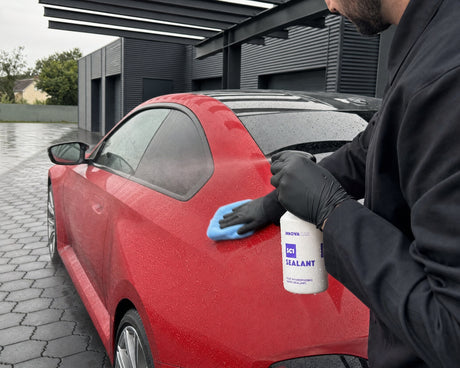
How long a sealant has to cure before the next shower hits.
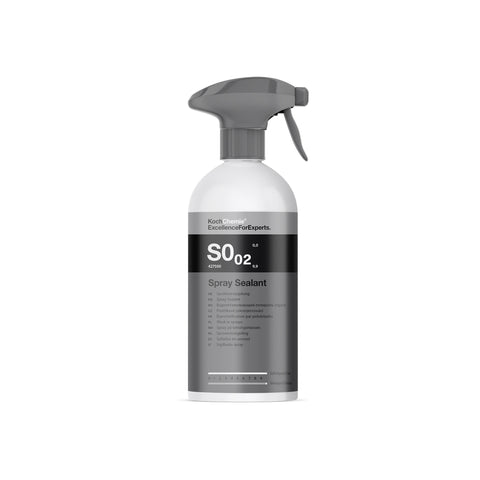
Koch-Chemie
Spray Sealant "S0.02" Spray Sealant
Spray sealant for glossy paintwork and perfect protection

SONAX
XTREME Ceramic Spray Sealant Spray-On Sealant
Ceramic Spray Sealant — 4 Months Protection, Si-Carbon


GYEON
GYEON Q²M WetCoat – SiO₂ wet sealant directly after washing
Dr. Wack "A1"
Spray wax for wet or dry paint — pH-neutral, no waiting time
Koch-Chemie
WetGloss "Wg" Wet Coat Sealant for Extra Gloss and Strong Hydrophobicity
RTU Wet Sealant with Aminosilane for Gloss and Beading in Minutes


Meguiars
Ultimate Quik Wax Spray Wax Sealant
Spray wax — real wax protection in 5 minutes after every wash


INNOVACAR
"SC0" Hydro Sealant Spray Sealant
Spray Sealant for Protection & Shine in one Step
Dr. Wack "A1"
A1 "ALL in ONE" Care & Protect Spray Sealant
Multisurface-Sprühversiegelung für alle Außenflächen — ohne Wartezeit
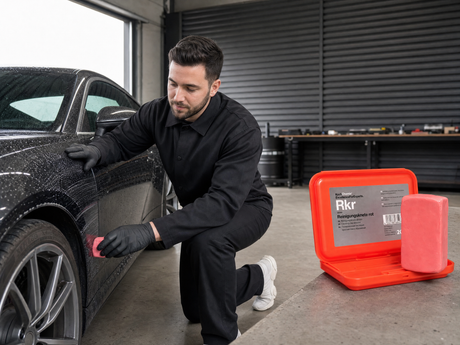
Claying and degreasing pays off in durability.
Koch-Chemie
Hand Wax "W0.01" Carnauba Wax Sealant
High-quality carnauba wax for long-lasting shine and protection


GYEON
Q²M Cure (REDEFINED) Ceramic Spray Sealant
Ceramic Spray Sealant – Coating refreshed every 2 months
What is a paint sealant? A thin protective layer on the clear coat that keeps out water, dirt and UV and carries the gloss. At Detailing1 you'll find four families: carnauba wax, synthetic polymers, silicon dioxide-based ceramics and graphene-infused sprays.
Lacquer sealing is the umbrella term for every protective layer that goes onto the clear coat after washing and shields it from the elements. It lays down as a wafer-thin film over the paint, fills in its fine roughness and lowers the surface energy so far that water no longer clings in sheets but pulls together into beads. The protection works against road salt, bird droppings, bug splatter, acid rain and UV. How long it lasts depends on the specific product, how it's applied and how the car is used.
Detailing1's tip from the shop: We often hear from customers whose twelve-month sealant stops beading after six weeks. It's almost never the product — it's the surface underneath. On paint that still has iron fallout, wax residue or polishing oils on it, the chemistry finds nothing to anchor to and just sits loosely on top. A simple test before you apply: slip a thin plastic sandwich bag over your fingers and run them over the dry paint. Anything that feels rough has to come off first. And be honest about the time: the first time round, most of the afternoon goes into prep, not application.
A sealant forms a renewable protective layer; some ceramic coatings raise the measured surface hardness in the process, without making the paint scratch-proof.
Under magnification, clear coat isn't a smooth surface. It has fine valleys and pores where road film, brake dust and bug residue get snagged. A sealant fills exactly that structure and closes the surface. In practice you notice it when dirt drops off under the hose at the next wash instead of needing the wash mitt to shift it.
The second part of the job is chemical. Bird droppings are acidic and etch into the clear coat within hours in the sun. Bug splatter brings its own enzymes, road salt attracts moisture and holds it against the surface. The protective layer takes the hit and gives up a little of itself at that spot. That's not a flaw — that's its job.
Then there's sun protection. Over the years, UV breaks down the binders in the clear coat, starting on the roof and bonnet, where it shows as a dull, slightly chalky tone. Sealants contain UV absorbers that soak up part of the radiation. A car without a garage or carport gains noticeably from that.
The benefit most people underestimate is less cleaning effort. Less grip means less contact with towel and mitt, and every contact is a chance for new swirls. Seal and you'll polish less often; polish less often and you use up less clear coat. Over a car's lifetime, that's the real gain in substance.
The limits are part of the deal: no sealant in this category makes paint scratch-proof. Stone chips, brush marks from the car wash and wipe marks from dry dust are still possible. Some coatings can improve scratch resistance to a limited degree; for protection against stone chips, a suitable paint protection film is the tool for the job.
Four chemical families share this category, and they differ far more in durability, effort and looks than in how well they protect on day one.
Carnauba wax is the classic and comes from the leaves of a Brazilian palm. At around 83 degrees it has the highest melting point of all natural waxes, which is why it doesn't run off a sun-baked bonnet. Nothing beats it for looks: the layer breaks light slightly diffusely and lays a warm depth over dark colours that looks as if there's water on the paint. SONAX quotes several weeks for natural waxes; the individual product's specs are what count. The whole field is under Wax sealant.
According to SONAX, polymer sealants form a more closed film than wax and can last several months. The exact bonding and durability depend on the formula and the product's specs. The gloss is clearer and cooler than wax. A preservation wax you apply wet is the Koch-Chemie Protector-Wax „Pw" Preservation Wax, which goes straight onto the wet car as a wet-coat sealant and gets rinsed off again in the final rinse.
Ceramic means silicon dioxide — the compound of silicon and oxygen that window glass is also made of. As it cures, the molecules link up into a network of alternating silicon and oxygen atoms that's much harder and more chemically resistant than any wax. In plain terms: the layer survives cleaners, rain and washes that would strip a wax layer in weeks. The SONAX XTREME Ceramic Spray Sealant Spray-On Sealant represents this group; the full field is under Spray sealants.
Graphene is the newest arrival. Manufacturers blend graphene oxide into the silicon dioxide matrix and promise a more flexible layer, fewer water spots and a lower surface temperature. Our honest take: the measurable edge over a good ceramic layer is small in everyday use, and independent comparison data is thin. If you're already getting good results with silicon dioxide, you gain little by switching. If you're just starting out, you can't go wrong with a graphene spray either.
A fifth group sits alongside without being a protective layer itself. Quick Detailer products maintain the existing sealant, refresh the beading and pick up light dust between washes. They don't replace a base sealant — they extend its life.
Contact angle is the number behind the beading, and together they tell you more about a layer's condition than anything on the bottle.
It's the angle at which the edge of a water droplet meets the paint surface. Picture the droplet in cross-section: if it spreads out flat like a fried egg, the angle is small; if it stands up like a ball, it's large. Fresh, unsealed clear coat sits at about 70 to 80 degrees, wax takes it to around 90, a polymer to 100, a ceramic layer to 105 to 110 degrees. Rule of thumb: the steeper the angle, the smaller the contact area and the less grip the droplet has.
The threshold is 90 degrees. Below it, the surface is called hydrophilic — water seeks it out. Above it, the surface is hydrophobic and repels water. Day to day, that's exactly the point that decides whether road film spreads across the paint with the water or runs back off with the droplets.
Beading and sheeting are the two visible forms of this. Beading means water stands on the paint in round, clearly defined beads. Sheeting means it pulls together into one connected film and runs off in a single sheet. Both show an intact layer. When drying, sheeting is the more pleasant trait, because far less water is left on the car.
One thing hardly anyone has on their radar: strong beading can encourage water spots. The droplet stays put, dries in the sun and leaves its limescale behind as a ring. How fast that happens depends on water hardness, measured in degrees of German hardness. From around 14 degrees, water counts as hard — and then you really need a drying towel after washing, no matter how well the layer beads.
A bucket of water is all you need to check. If it runs off in tight, round beads, the layer is working. If the beads get wider even after washing and decontamination and patches stay wet, the contact angle has dropped and the next application is due. This test is more reliable than any calendar, because it reflects what your car is actually going through.
Three axes drive the choice, and they rarely pull in the same direction.
Durability spans three orders of magnitude. Weeks for natural wax, months for polymer and ceramic spray, years for ceramic coatings that cure on the paint. The manufacturer lists the conditions that go with it for each product. How much weather, winter use and washing cut into that depends on the specific product; a fixed reduction isn't reliable without product-specific evidence.
The effort axis runs exactly opposite to the convenience a lot of people expect. A wet sealant like the Koch-Chemie Hydro Foam Sealant „S0.03" Wet-Coat Sealant Concentrate goes through the foam lance and costs you five minutes at the end of the wash. A spray sealant takes twenty to thirty minutes and a dry, clean car. A hand wax with applying, hazing and buffing takes up half a day.
Looks don't follow a ranking — they follow taste and paint colour. On black, dark blue and burgundy, carnauba wax plays to its strengths, because the soft refraction creates depth. On white, silver and light metallics, a ceramic layer does more, because it reflects hard and clear and makes the metallic flake pop.
It pays to do the maths per month rather than per bottle. A cheap wax that goes on six times a year costs more time over twelve months, and usually more money, than a ceramic spray with two applications. If an afternoon with the car is your hobby, you'll flip that maths on purpose.
What we see again and again day-to-day: people buy too much durability and plan too little prep. The longest-lasting sealant in the range will last less time on unprepared paint than the simplest wax on properly prepped paint. If time is tight, put it into decontamination rather than the pricier product.
Application itself is quick — everything before it decides the result.
It starts with a wash as per the manufacturer's spec, with no gloss or wax additives; for Koch-Chemie 1K-Nano, a thorough alkaline clean is specified. Additives like that leave a film on the paint that the sealant can't grip afterwards. The right shampoo for this is under Car shampoo. Two buckets, one for washing and one for rinsing, keep the dirt out of your mitt.
Then comes decontamination. First iron remover for embedded iron particles, then clay bar for organic residue like tree sap and tar. If swirls are visible, now's the time to polish, because a sealant locks in every scratch for its whole lifespan. Finally, a panel wipe takes off the polishing oils — otherwise the layer sits on oil instead of paint.
Application and removal depend on the product. Koch-Chemie 1K-Nano is worked in panel by panel with a suitable sponge and removed with the specified microfibre towel following the set steps. Direct sun and warm panels are the most common cause of streaks.
High spots are the typical pitfall — areas with too much product that cure into a milky haze. They only show under raking light, so check every panel from a low angle. As long as nothing has fully cured, you can take a high spot off with a slightly damp towel. After that, only polishing will help.
After application, the chemistry needs peace and quiet. Dry time, rain protection and the first wash depend on the product: for Koch-Chemie Ceramic Body "Cb0.01", at least 24 hours until weatherproof and nine days until the first wash are specified. Weatherproof doesn't yet mean fully cured. Wet sealants are the exception — they go straight onto wet paint and get rinsed off.
The routine afterwards doesn't take much. Wash with pH-neutral shampoo, then hit the still-damp surface with a quick detailer like the Koch-Chemie Quick & Shine „Qs" Quick Detailer after the wash, and in between use the Koch-Chemie Wash & Finish „Wf" Waterless-Wash Detailer for dust when a full wash isn't worth it.
The choice comes down to three questions: how much time do you have, where does the car live, and what colour is the paint?
If time is short and the car lives outside, a wet sealant is the cheapest way into long-lasting protection. The Koch-Chemie Protector-Wax „Pw" Preservation Wax goes on in the final rinse and builds up another layer with every wash. If you can set aside more time once every six months, the SONAX XTREME Ceramic Spray Sealant Spray-On Sealant will go the distance.
With dark paint and a love of hand work, there's no way round wax. The depth carnauba creates on black paint is something chemistry can't reproduce any other way, and for many people the short durability is part of the ritual rather than a drawback. The selection is under Wax sealant.
If your car wears paint protection film, different rules apply. Film is softer than clear coat and more sensitive to solvent-based products. The GYEON Q²M „PPF" Maintain (REDEFINED) Spray Sealant for Paint Protection Film is built exactly for that and preserves the film's self-healing properties instead of sealing them off.
If there's already a ceramic layer on the car, you don't need a new base sealant — you need maintenance. The Koch-Chemie Finish Spray Exterior „Fse" Quick Detailer with Kalk-EX also takes care of limescale rings from hard tap water, while the SONAX XTREME Ceramic QuickDetailer Quick-Detailer tops up the silicon dioxide and gets the beading back up.
And if you're after the bigger picture: which kind of protection wheels, glass, leather, fabric, plastic, engine bay and film need is shown under Protection. It all starts with a clean wash and the paint prep that's needed. Whether you dry before sealing or apply the product to wet paint and rinse it off afterwards depends on the sealant you've picked. The order matters more than the label on the bottle.
Too much choice in Lacquer sealing? Get help picking:
Daniel von Detailing1 |

Daniel von Detailing1 |

Jasper von Detailing1 |

Daniel von Detailing1 |

Daniel von Detailing1 |

Daniel von Detailing1 |

Jasper von Detailing1 |

Jasper von Detailing1 |

Daniel von Detailing1 |

Daniel von Detailing1 |

Daniel von Detailing1 |

Daniel von Detailing1 |


